


 English
 中文简体
中文简体
 عربى
عربى

Content
- 1 Why WPC Door Frames Are Replacing Traditional Wood in Modern Construction
- 2 What WPC Door Frame Material Is Made Of and How Composition Affects Performance
- 3 WPC Door Frame vs. Solid Wood vs. PVC: Side-by-Side Performance
- 4 Standard WPC Door Frame Profiles, Dimensions, and Configuration Options
- 5 Technical Specifications to Request and Verify Before Purchase
- 6 Step-by-Step Guide to Installing a WPC Door Frame Correctly
- 7 Common WPC Door Frame Installation Mistakes and How to Avoid Them
- 8 Maintaining a WPC Door Frame: What Regular Upkeep Actually Involves
Why WPC Door Frames Are Replacing Traditional Wood in Modern Construction
A WPC door frame — manufactured from Wood Plastic Composite, a blend of wood fiber and thermoplastic polymer — has emerged as one of the most practical alternatives to solid wood door frames in both residential and commercial construction over the past decade. The shift is driven by a straightforward set of performance advantages: WPC frames do not rot, do not swell significantly when exposed to humidity, resist termite and fungal attack without chemical treatment, and maintain their dimensional accuracy over years of use in conditions that would cause solid wood frames to warp, split, or degrade.
A door frame — also referred to as a door casing, door architrave assembly, or door buck depending on the market and application — performs several simultaneous functions. It provides the structural boundary against which the door slab closes and latches, carries the load of the hinges and the door weight, seals the gap between the door assembly and the rough opening in the wall, and presents a finished decorative face to both sides of the opening. Every one of these functions places demands on the frame material: structural rigidity, dimensional stability under load and humidity cycling, surface quality that accepts paint or veneer finishes, and adequate density to hold screws and hinge hardware securely over many years of daily use.
WPC door frames address each of these demands better than solid wood in high-humidity environments and better than pure PVC in applications where structural rigidity and surface finish quality are priorities. Understanding exactly what WPC door frames are made of, how they are produced, what profiles and dimensions are available, and how to specify and install them correctly is the foundation for making a purchasing decision that delivers long-term value.
What WPC Door Frame Material Is Made Of and How Composition Affects Performance
The performance characteristics of any WPC door frame are determined directly by its material composition — the species and particle size of the wood fiber used, the type and proportion of thermoplastic polymer in the matrix, and the chemical additives incorporated to control processing behavior and long-term durability. These variables are not standardized across the industry, which is why WPC door frames from different manufacturers can perform very differently despite appearing similar from specifications and product photos.
Wood Fiber Content and Type
Wood fiber content in WPC door frames typically ranges from 40% to 65% by weight. The wood component contributes stiffness, compressive strength, screw-holding capacity, and the natural aesthetic that makes WPC visually warmer than pure plastic alternatives. Common fiber sources include pine, poplar, bamboo, rice husk, and recycled wood flour from sawmill waste. Finer particle sizes — wood flour rather than coarse wood chips — produce a denser, more uniform composite with better surface finish quality and higher flexural strength. Coarser fiber improves toughness but can create surface texture irregularities and weaker inter-phase bonding if the coupling agent system is not optimized for the fiber geometry.
The moisture content of the wood fiber before compounding is a critical processing parameter: wood flour must be dried to below 2 to 3% moisture content before entering the extruder. Higher residual moisture causes steam generation during hot processing, producing internal voids, surface blistering, and dramatically reduced mechanical properties in the finished frame profile. This is why WPC quality is so sensitive to the quality control discipline of the manufacturing facility — a parameter the end-user cannot verify from the finished product without destructive testing.
Polymer Matrix: PVC vs. PE vs. PP
Three thermoplastic polymers dominate WPC door frame production. PVC (polyvinyl chloride) is the most widely used for interior door frames because of its excellent dimensional stability, superior surface hardness, flame retardancy relative to polyolefins, and ability to accept paint and laminate finishes without primer. PVC-based WPC frames are stiffer than PE or PP equivalents at comparable wood fiber content. Polyethylene (PE), particularly high-density polyethylene (HDPE), produces a tougher, more impact-resistant composite with better low-temperature performance but lower surface hardness and stiffness. PE-based WPC is more commonly used in exterior decking and cladding than in door frames. Polypropylene (PP) offers good stiffness and chemical resistance but has higher processing temperatures that can degrade wood fiber quality if not carefully controlled, and is less common in door frame applications.
Additives and Their Functions
The additive package in a WPC door frame formulation controls multiple performance parameters that are invisible from the product surface but decisive for long-term durability. Coupling agents — typically maleic anhydride-grafted polymers — chemically bond the hydrophilic wood fiber to the hydrophobic polymer matrix, improving inter-phase adhesion and dramatically reducing moisture uptake. Without adequate coupling agent content, water migrates along the wood-polymer interface over time, causing internal delamination and progressive strength loss. Heat stabilizers prevent polymer degradation during extrusion processing. UV stabilizers are incorporated in WPC frames intended for semi-exposed applications near windows or external doorways. Biocides provide protection against mold and mildew growth within the composite matrix. Flame retardants — aluminum trihydrate (ATH) or antimony trioxide combinations — are added to formulations requiring enhanced fire performance for commercial or institutional applications.
WPC Door Frame vs. Solid Wood vs. PVC: Side-by-Side Performance
Selecting a door frame material requires balancing performance, cost, aesthetics, and maintenance requirements against the specific demands of the installation environment. The comparison below covers the properties most relevant to door frame performance across residential and commercial applications.
| Property | WPC Frame | Solid Wood Frame | Pure PVC Frame |
|---|---|---|---|
| Moisture Resistance | Excellent | Poor–Fair | Excellent |
| Dimensional Stability | Very Good | Fair (seasonal movement) | Good (thermal expansion) |
| Screw / Hardware Retention | Very Good | Excellent | Poor–Fair |
| Termite / Rot Resistance | Very Good | Poor (untreated) | Excellent |
| Surface Finish Quality | Good–Very Good | Excellent | Fair |
| Paintability | Good | Excellent | Requires primer |
| Flexural Rigidity | Good | Very Good–Excellent | Fair (hollow profiles) |
| Maintenance Required | Low | High | Very Low |
| Relative Cost per Linear Meter | Medium | Medium–High | Low–Medium |
The comparison positions WPC door frames clearly: they are the strongest choice where moisture resistance, biological durability, and adequate hardware retention must coexist — bathroom doorways, kitchen areas, ground-floor installations in humid climates, and buildings without air conditioning where seasonal humidity variation is significant. Solid wood retains an advantage in premium decorative applications and where very high structural loads must be transferred through the frame. Pure PVC frames remain appropriate where absolute minimum maintenance and maximum moisture resistance outweigh all other considerations and where aesthetic quality requirements are modest.
Standard WPC Door Frame Profiles, Dimensions, and Configuration Options
WPC door frames are produced in a range of standard profiles that correspond to the most commonly required wall thicknesses, door slab dimensions, and architectural styles across residential and commercial construction. Understanding the profile system is necessary for correct specification and for avoiding the expensive error of ordering frame components that do not suit the wall construction or door dimensions of the project.
Frame Width (Jamb Depth) and Wall Thickness
The most critical dimension in door frame specification is the jamb depth — the width of the frame profile measured perpendicular to the door face, which must match the wall thickness at the door opening. Standard jamb depths in the WPC door frame market range from 90 mm to 200 mm, with the most common sizes being 90 mm, 100 mm, 120 mm, 140 mm, and 150 mm. These correspond to the most frequently encountered wall constructions: single brick with plaster (approximately 120–130 mm), double brick (approximately 250 mm — requires a wider frame or frame extension), lightweight steel frame with plasterboard (90–100 mm), and concrete masonry with render (140–160 mm). Specifying a frame with a jamb depth that does not match the wall thickness creates a visible step between the frame face and the wall surface that requires additional architrave cover — always measure the actual finished wall thickness at the rough opening before ordering frames.
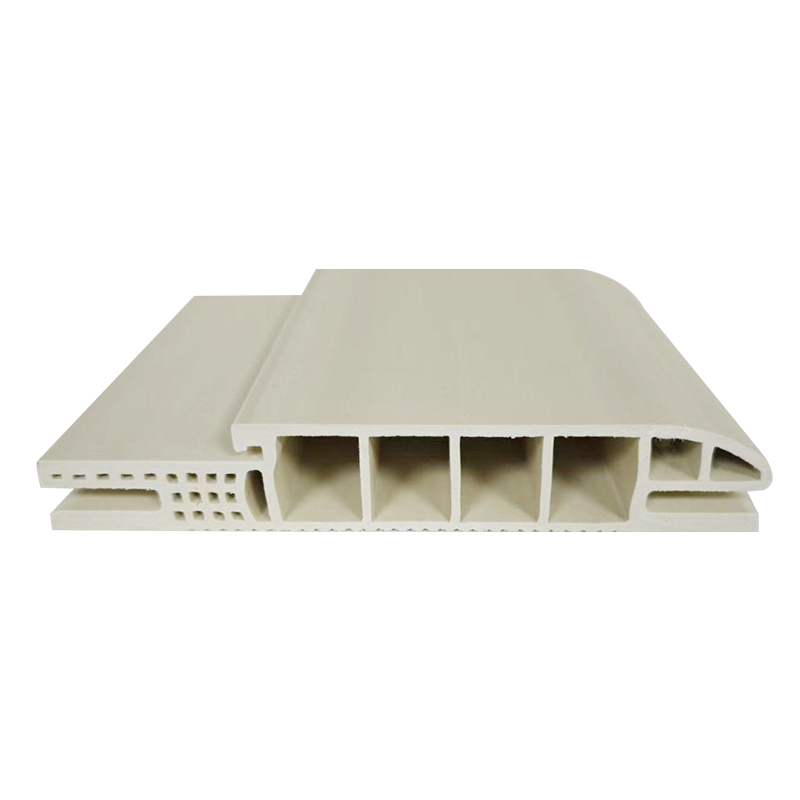
Door Stop Profile Integration
WPC door frames are produced in two primary stop configurations: integrated stop profiles, where the door stop rebate is machined or co-extruded as part of the frame profile, and applied stop systems, where a separate stop strip is fixed to the frame face after installation. Integrated stops are more common in factory-assembled door frame sets where the frame is pre-cut and pre-assembled to receive a specific door slab size. Applied stops allow more flexibility in door slab thickness accommodation and are often preferred in commercial installations where door slab specifications may vary across different door types within the same building. Standard door stop heights above the frame face are typically 12 mm to 15 mm, accommodating standard door slab thicknesses of 35 mm and 40 mm.
Architrave Profile Design
The architrave — the decorative molding that covers the joint between the door frame and the wall face — is an integral part of the WPC door frame system and is typically supplied by the same manufacturer as a coordinated component. WPC architrave profiles are available in flat, ovolo, ogee, and stepped geometric designs to suit different interior styles from contemporary minimalist to traditional. Architrave face widths range from 45 mm to 90 mm for standard residential applications, with wider profiles available for commercial and hospitality projects where a more prominent frame presence is desired. The back profile of the architrave should include a relief channel to accommodate wall surface irregularities and ensure the face sits flat against the wall without visible gaps.
Assembled Door Frame Sets vs. Component Supply
WPC door frames are available either as pre-cut, pre-assembled sets — supplied with two vertical jambs, a head jamb, and matching architrave cut to specified door opening dimensions — or as linear meter component stock that is cut and assembled on-site or in a joinery workshop. Pre-assembled frame sets reduce site labor time and cutting waste but require accurate opening dimensions to be confirmed before ordering, as modifications to pre-cut components are time-consuming. Component supply is more flexible for projects with non-standard opening sizes or where a single supplier is providing frames for multiple different opening dimensions and wall thicknesses across a large development.
Technical Specifications to Request and Verify Before Purchase
WPC door frame quality varies significantly between manufacturers, and the specifications most relevant to long-term performance are not always disclosed proactively in product listings or sales materials. Requesting and verifying the following data points before committing to a supplier protects against selecting a product that fails prematurely or does not meet project compliance requirements.
- Density: Higher-density WPC frames — typically 900 to 1,100 kg/m³ for solid-section profiles — provide better screw retention, impact resistance, and structural rigidity than lower-density alternatives. Density below 750 kg/m³ in a solid-section WPC frame profile is a warning indicator of either high void content from processing defects or a very low wood fiber ratio that compromises structural performance.
- Moisture absorption (24-hour water immersion): Request test data per ISO 62 or equivalent. Premium WPC door frame profiles should absorb less than 1.5% by weight after 24-hour immersion. Values above 3% indicate insufficient coupling agent or polymer encapsulation of wood fiber, which will manifest as dimensional instability and surface degradation in humid environments over time.
- Flexural strength (Modulus of Rupture): For door frame jambs carrying hinge and strike plate loads, a minimum MOR of 35 MPa is a reasonable benchmark. Heavy-duty commercial doors with self-closing hardware and frequent use cycles require frame profiles with MOR values of 45 MPa or higher to resist long-term deformation at hinge fixing locations.
- Screw pull-out resistance: Ask for screw withdrawal force data measured perpendicular to the profile face. A value of at least 1,200 N per screw at standard hinge screw dimensions (4 mm × 40 mm) is a practical minimum for single-door residential applications. Commercial doors with heavy slabs or closer hardware require higher pull-out values — request test data at the specific screw dimensions used in the hardware specification.
- Formaldehyde emission classification: Confirm E1 (≤0.1 mg/m³) or E0 (≤0.05 mg/m³) classification per EN 717-1, or CARB Phase 2 compliance for projects in North America. Unclassified WPC profiles should not be used in occupied interior spaces regardless of cost advantage.
- Linear thermal expansion coefficient: WPC frames expand and contract with temperature changes. The linear thermal expansion coefficient of a PVC-based WPC profile is typically 40 to 60 × 10⁻⁶/°C — higher than solid wood but lower than pure PVC. For long frame lengths (above 2.4 m in climates with large temperature variation), verify the manufacturer's recommendations for expansion gap allowances at frame joints and wall fixing details.
Step-by-Step Guide to Installing a WPC Door Frame Correctly
Correct installation is as important as material quality in determining whether a WPC door frame performs as intended and remains square, secure, and gap-free over years of use. The installation sequence below applies to standard in-wall single door frames in masonry or timber stud construction and covers the critical steps that are most frequently handled incorrectly on-site.
Preparing the Rough Opening
The rough opening must be plumb, square, and at least 20 mm wider and 15 mm taller than the nominal door frame external dimensions to allow for shimming and leveling. Check the opening with a spirit level on both vertical faces and across the head — a twisted or out-of-square opening transmits into the installed frame and cannot be fully corrected by shimming alone. Remove all debris, protruding fixings, and loose masonry from the opening perimeter. In wet areas, apply a waterproof membrane to the floor threshold area and at least 150 mm up the side walls before frame installation to protect the wall substrate from moisture that will inevitably reach the frame base over time.
Assembling the Frame Set
If supplied as a pre-cut frame set, assemble the head jamb to both side jambs using the manufacturer's supplied corner connectors or by cutting the head jamb to length and joining with polyurethane adhesive and stainless steel screws at the corner joints. Verify the assembled frame is square by measuring diagonals — both diagonal measurements must be equal within 2 mm. A diagonal difference greater than this indicates a corner joint angle error that will cause the door slab to bind or gap unevenly when hung. Brace the assembled frame with a temporary timber spreader across the base of the two side jambs set to the exact internal frame width to maintain squareness during installation.
Setting and Fixing the Frame in the Opening
Position the assembled frame in the rough opening with the frame face flush with the intended finished wall surface plane. Shim behind the hinge jamb first — this is the most structurally critical side — using hardwood or composite shim pairs at hinge locations and at the head jamb corner. Check the hinge jamb for plumb in both planes (face plane and edge plane) and adjust shims until plumb is confirmed with a spirit level. Fix the hinge jamb through the shims into the wall structure using 100 mm × 6 mm countersunk stainless steel screws at each shim location. Plumb and fix the strike jamb, confirm diagonal measurements of the frame opening have not changed from the pre-installation check, then fix the head jamb through shims into the lintel or top plate. Remove the temporary base spreader only after all fixings are in place and the frame is confirmed square.
Filling and Sealing the Frame Perimeter
Fill the gap between the WPC frame and the rough opening wall with low-expansion polyurethane foam, applied in sections and allowed to cure before the next section is added to prevent the expansion pressure from pushing the frame out of plumb. Standard expanding foam generates significant force during cure — apply in thin passes of no more than 15 mm depth per application and monitor frame plumb at each stage. After foam has cured, trim flush with a sharp knife. Apply a continuous bead of paintable acrylic or silicone sealant at the joint between the frame face and the wall surface on both sides before fitting the architrave. This sealant line, concealed by the architrave, prevents moisture migration behind the frame in wet area installations.
Fitting the Architrave
Fix the architrave to the wall surface using a combination of construction adhesive applied to the back face and finish nails or brad nails driven through the architrave face into the wall substrate at 400 mm centers. The inside edge of the architrave should overlap the frame edge by a consistent reveal — typically 5 to 8 mm — on all three sides of the opening. Miter the architrave corners at 45 degrees; a poorly cut miter joint is the most visible indicator of low-quality installation. Fill nail holes and miter joint gaps with interior-grade acrylic filler, allow to dry, sand flush, and paint to complete the installation.
Common WPC Door Frame Installation Mistakes and How to Avoid Them
Even experienced installers encounter WPC-specific issues if they approach the material with assumptions formed from solid wood door frame installation. The following mistakes account for the majority of WPC door frame callbacks and warranty claims in residential and commercial projects.
- Using standard wood screws without pilot holes near edges: WPC has a higher density and lower fiber split resistance than solid wood near cut edges and profile ends. Driving screws without pilot holes within 50 mm of the frame end or profile edge creates surface cracks that propagate over time. Always pre-drill pilot holes at a diameter approximately 80% of the screw shank diameter at any fixing location near a profile end.
- Over-applying expanding foam: The most common cause of installed frames going out of plumb is excessive foam expansion during cure pushing the jamb off the shimmed position. Use minimal-expansion foam formulations specifically designed for door and window frame applications, and monitor frame plumb throughout the foam application and cure process.
- Leaving cut ends unsealed in wet areas: Any cross-cut through a WPC frame profile exposes the internal composite structure to direct moisture contact at the cut face. In bathroom thresholds and wet area installations, apply an end-grain sealant — compatible with the WPC formulation — to all cut faces before installation. Failure to do this is the leading cause of progressive frame base deterioration in bathroom door installations.
- Installing frames in direct contact with the floor substrate: Maintain a minimum 10 mm clearance between the WPC frame base and the finished floor surface. Direct contact with wet mopping water, floor cleaning solutions, or standing water after showering creates sustained moisture exposure at the frame base that accelerates material degradation even in well-formulated WPC profiles.
- Specifying frame jamb depth without measuring finished wall thickness: Nominal wall thicknesses in construction drawings frequently differ from actual finished wall thicknesses after plastering, tiling, or other surface treatments. Always measure the actual wall thickness at the rough opening — at multiple points across the opening height — and specify the frame jamb depth accordingly. A 5 mm error in jamb depth creates a visible and difficult-to-correct step between the frame face and the finished wall surface on one or both sides of the opening.
- Applying incompatible adhesives for corner joints or architrave fixing: Standard PVA wood glue has significantly reduced bond strength on WPC surfaces due to the low surface energy of the plastic matrix. Use two-component polyurethane adhesive or solvent-based contact cement formulated for composite materials at all WPC-to-WPC and WPC-to-substrate bonding locations.
Maintaining a WPC Door Frame: What Regular Upkeep Actually Involves
One of the practical advantages of WPC door frames over solid wood is the substantially reduced maintenance burden across the frame's service life. A correctly installed WPC frame in a standard interior application requires very little routine attention — but understanding what the maintenance program actually consists of, and what conditions can reduce the frame's service life if ignored, allows building owners and facilities managers to make accurate lifecycle cost comparisons.
Routine cleaning of WPC door frame surfaces requires nothing more than wiping with a damp cloth and a mild detergent solution. Unlike painted solid wood frames, a film-laminated or UV-coated WPC frame does not require periodic repainting to maintain moisture protection — the surface protection is inherent in the material rather than dependent on a surface coating applied by the installer. This eliminates the 3 to 5 year repainting cycle that adds both cost and disruption to solid wood frame maintenance programs in commercial buildings.
Annual inspection of sealant joints — particularly at the frame-to-wall perimeter joint concealed behind the architrave, and at the threshold joint between the frame base and the floor — is the most important maintenance task for WPC frames in wet area or ground-floor applications. Sealant degrades over time through UV exposure, thermal cycling, and chemical exposure from floor cleaning products. Replacing failed sealant at the first sign of cracking or adhesion loss prevents moisture from penetrating behind the frame and reaching wall substrates that are far less moisture-resistant than the frame itself.
Hinge and strike hardware should be checked annually for loosening — particularly in high-traffic commercial applications where the cumulative load on hinge screws from thousands of daily door cycles can cause screw hole enlargement over time. If a hinge screw location shows any sign of pull-out, address it immediately by installing a larger diameter screw, filling and re-drilling the hole with composite filler, or repositioning the hinge to virgin material. Early intervention prevents the progressive frame damage that results from a hinge that continues to operate in a compromised fixing location.


