


 English
 中文简体
中文简体
 عربى
عربى

Content
- 1 What a WPC Door Panel Actually Is and What Makes It Different
- 2 How WPC Door Panels Are Manufactured: The Process Behind the Product
- 3 WPC Door Panel vs. Solid Wood, HDF, and PVC: A Direct Comparison
- 4 Types of WPC Door Panels and Which Applications They Suit
- 5 Key Performance Properties to Verify Before Purchasing
- 6 Installation Considerations for WPC Door Panels
- 7 Surface Finish Options and How They Affect Appearance and Durability
- 8 Maintenance and Long-Term Care for WPC Door Panels
What a WPC Door Panel Actually Is and What Makes It Different
A WPC door panel is a door skin, facing, or full door body manufactured from Wood Plastic Composite — a material that combines wood fiber or wood flour with thermoplastic polymers, most commonly PVC, polyethylene (PE), or polypropylene (PP), along with chemical additives that control processing behavior, surface hardness, UV resistance, and long-term dimensional stability. The result is a material that carries the visual warmth and workability of wood alongside the moisture resistance, dimensional stability, and low maintenance requirements of plastic — characteristics that neither material achieves well on its own.
Wood content in WPC door panels typically ranges from 40% to 70% by weight, with the remainder made up of the polymer matrix and additives. Higher wood content generally produces a denser, heavier panel with a more authentic wood-like surface texture and better paint adhesion, but also greater sensitivity to moisture if the polymer encapsulation is incomplete or the surface finish is compromised. Lower wood content panels are lighter and more moisture-resistant but may feel less substantial and require more surface treatment to achieve a convincing wood appearance.
WPC door panels are used in two primary configurations: as decorative surface panels laminated onto a structural door core (such as a hollow core or solid timber frame), and as structural door slabs where the WPC material itself provides both the decorative surface and the structural body of the door. Both configurations are widely manufactured and commercially available, and the right choice depends on the application, the required performance level, and the installation environment.
How WPC Door Panels Are Manufactured: The Process Behind the Product
Understanding the manufacturing process helps explain why WPC panels perform as they do and why quality varies significantly between manufacturers even when products appear similar from specifications alone.
Raw Material Preparation
Wood fiber or wood flour — derived from sawmill waste, wood shavings, rice husks, bamboo fiber, or other agricultural byproducts — is dried to a moisture content below 3% before compounding. Residual moisture in the wood component causes steam formation during hot processing, creating voids, surface blistering, and structural weakness in the finished panel. The thermoplastic polymer is supplied in pellet or powder form and blended with the dried wood fiber along with coupling agents (typically maleic anhydride-grafted polymers) that chemically bond the wood and plastic phases together, and stabilizers, lubricants, colorants, and UV inhibitors as required by the intended application.
Extrusion or Hot Press Forming
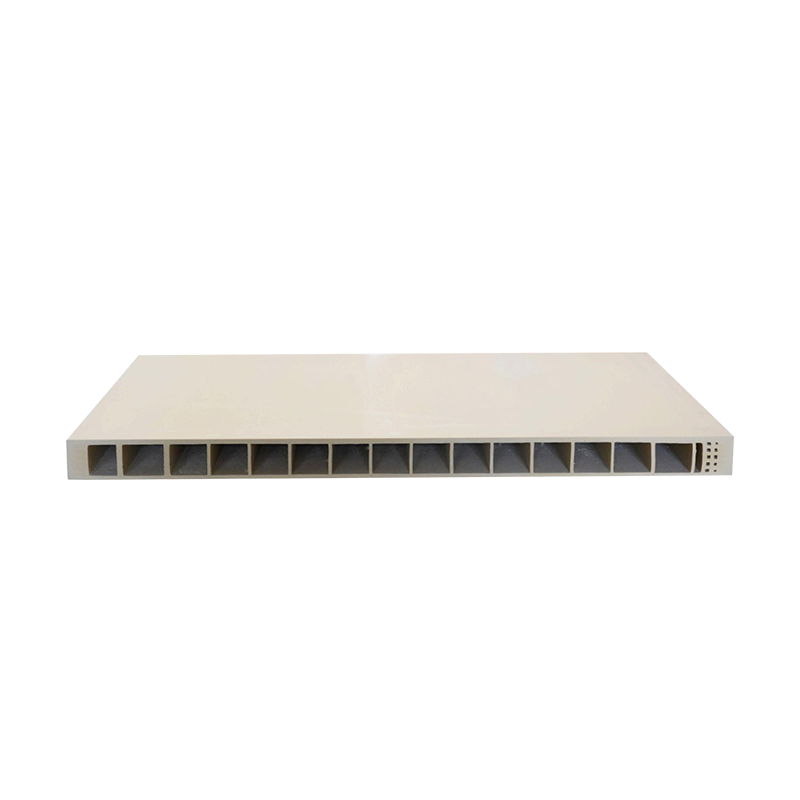
Most WPC door panels are produced by one of two primary forming methods. Extrusion forces the compounded material through a shaped die under heat and pressure, producing continuous profiles of uniform cross-section that are cut to length. Extruded WPC panels can incorporate hollow internal chambers that reduce weight and material cost while maintaining structural performance. Hot press forming compresses a mat of blended WPC material between heated steel platens at pressures typically ranging from 2 to 8 MPa, producing flat panels with high surface density and excellent dimensional accuracy. Hot-pressed panels are generally used for door skins and flat decorative panels, while extruded profiles dominate structural door frame and edge components.
Surface Treatment and Finishing
After forming, WPC door panels receive surface treatments that determine their aesthetic appearance and surface performance. Common finishing options include embossing with wood grain or geometric texture patterns during the hot press cycle, lamination with decorative foil or PVC film, direct painting with UV-cured coatings, and solid-color co-extrusion where the surface color layer is applied as part of the extrusion process rather than as a post-process coating. The surface finish quality — evenness of texture, adhesion of any applied film or coating, and resistance to peeling or delamination — is one of the most significant quality differentiators between premium and budget WPC door panels, and is difficult to assess from product specifications alone without physical samples.
WPC Door Panel vs. Solid Wood, HDF, and PVC: A Direct Comparison
WPC door panels compete directly with solid wood, HDF (High Density Fiberboard) faced panels, and pure PVC panels across most residential and commercial door applications. Each material has genuine strengths and specific limitations, and the right choice depends on the installation environment, maintenance expectations, budget, and aesthetic requirements.
| Property | WPC Door Panel | Solid Wood | HDF Panel | Pure PVC Panel |
|---|---|---|---|---|
| Moisture Resistance | Excellent | Poor–Fair | Poor | Excellent |
| Dimensional Stability | Very Good | Fair (seasonal movement) | Good when dry | Good |
| Surface Aesthetics | Good–Very Good | Excellent | Good | Fair |
| Screw / Hardware Holding | Very Good | Excellent | Good | Poor–Fair |
| Termite / Rot Resistance | Very Good | Poor (untreated) | Fair | Excellent |
| Paintability | Good | Excellent | Very Good | Requires primer |
| Unit Cost (relative) | Medium | Medium–High | Low–Medium | Low–Medium |
| Maintenance Required | Low | High | Medium | Very Low |
The comparison reveals that WPC door panels occupy a well-defined middle ground: they outperform solid wood and HDF decisively on moisture resistance and biological durability, outperform PVC on aesthetics and hardware holding, and compete favorably on cost with solid wood while requiring significantly less maintenance. The areas where WPC trails solid wood — surface aesthetics and ultimate screw-holding strength in structural applications — are meaningful in premium decorative contexts but rarely decisive in standard residential or commercial interior door applications.
Types of WPC Door Panels and Which Applications They Suit
WPC door panels are manufactured in several distinct configurations, each optimized for different performance requirements, installation contexts, and aesthetic outcomes. Specifying the wrong type for a given application is one of the most common procurement errors, particularly when buyers select panels based on price without confirming that the product type is appropriate for the installation environment.
Hollow-Core WPC Door Panels
Hollow-core WPC panels incorporate internal chambers within the extruded profile, reducing weight and material cost while maintaining the surface appearance and moisture resistance of solid WPC. They are widely used in interior bedroom and corridor doors where acoustic performance and impact resistance are not primary requirements. A typical hollow-core WPC interior door weighs 18 to 28 kg for a standard 2100mm × 900mm size, compared to 35 to 55 kg for a solid WPC equivalent. The hollow-core construction limits the load that can be applied to the panel face — glass inserts, heavy hardware, and applied decorative moldings should be evaluated against the specific panel's structural capacity before specification.
Solid-Core WPC Door Panels
Solid-core WPC panels are fully dense throughout their cross-section. They provide superior impact resistance, better screw and hardware retention, higher acoustic attenuation, and greater resistance to forced entry compared to hollow-core equivalents. Solid WPC door slabs are appropriate for bathroom doors, external-facing applications in covered or semi-enclosed areas, and commercial applications where door durability under high-traffic use is a primary concern. The additional weight requires robust hinges — typically three hinges per door rather than two — and door frame hardware rated for the higher load.
WPC Door Skin Panels
WPC door skins are thin decorative panels — typically 3 to 6 mm thick — bonded to both faces of a structural door core such as a hollow chipboard, LVL (Laminated Veneer Lumber), or steel framework. The door skin provides the decorative surface and weather protection while the core provides structural rigidity and dimensional stability. WPC-skinned doors are particularly common in mid-range residential construction, offering moisture-resistant surfaces at a lower system cost than fully solid WPC construction. The quality of the adhesive bond between the WPC skin and the core is critical — delamination at this interface, driven by differential thermal expansion or moisture cycling, is the most common failure mode in poorly manufactured WPC-skinned doors.
Foam-Core WPC Panels
Foam-core or cellular WPC panels use a foamed polymer core within the WPC matrix — created by introducing a blowing agent into the compound during extrusion — that reduces density while maintaining the external surface properties of standard WPC. Foam-core panels are the lightest WPC option, with densities as low as 0.6 to 0.8 g/cm³ compared to 1.1 to 1.4 g/cm³ for solid WPC. They are popular in wardrobe doors, decorative partition panels, and light-duty internal applications where weight is a concern but the full performance of solid WPC is not required. The foamed core reduces screw holding strength and impact resistance relative to solid panels, which should be factored into hardware specification.
Key Performance Properties to Verify Before Purchasing
WPC door panel specifications vary significantly between manufacturers, and marketing descriptions like "waterproof," "termite-proof," or "eco-friendly" are applied inconsistently across product quality tiers. Verifying actual performance through documented test data rather than accepting marketing claims at face value is essential for any procurement decision, particularly for commercial projects or high-humidity installations where panel failure would be costly to rectify.
Water Absorption and Thickness Swelling
Request water absorption data measured according to a recognized standard — ISO 62 or ASTM D570 are commonly applied. Premium WPC door panels should show water absorption of less than 1% by weight after 24-hour immersion, and thickness swelling of less than 0.5% under the same conditions. Panels with higher absorption values — often those with inadequate coupling agent content or incomplete polymer encapsulation of wood fibers — will eventually show dimensional changes, surface degradation, and reduced screw retention in humid environments. Bathroom and kitchen applications should always be specified with panels meeting stringent moisture performance criteria, not simply "moisture-resistant" marketing language.
Modulus of Rupture (MOR) and Flexural Strength
Flexural strength — measured as Modulus of Rupture (MOR) — indicates the panel's resistance to bending failure under load. For structural WPC door slabs used in standard residential applications, an MOR of at least 30 MPa is a reasonable minimum benchmark. Panels used in commercial applications with heavy hardware or wide door widths should be specified with higher MOR values — typically 40 MPa or above. Thin WPC door skin panels are not structural elements and should not be evaluated on MOR alone; in this case the bonding strength between the skin and core, and the structural performance of the assembled door system, are the relevant parameters.
Formaldehyde Emission
WPC panels contain wood fiber, and many formulations use urea-formaldehyde resins or other binders in the wood component. Formaldehyde emission from interior door panels contributes to indoor air quality degradation. Verify that panels meet recognized emission standards: E1 or E0 classification under EN 717-1 (Europe), CARB Phase 2 compliance (California/North America), or equivalent national standards. E0 classification (≤0.05 mg/m³ chamber concentration) represents the most stringent widely-adopted standard and is appropriate for bedrooms, children's rooms, and other spaces where occupants spend extended periods. Panels with no emission certification should not be used in occupied interior spaces.
Fire Performance Classification
WPC door panels contain both combustible wood fiber and thermoplastic polymer, making fire performance a relevant specification parameter for commercial, institutional, and multi-family residential applications subject to building code requirements. Fire performance is classified under EN 13501-1 in Europe (classes A1 through F) or ASTM E84 in North America (Class A, B, or C flame spread index). Standard WPC panels without fire-retardant additives typically achieve Class C or Class D ratings. Fire-retardant formulations incorporating aluminum trihydrate (ATH), magnesium hydroxide, or halogenated flame retardants can achieve Class B ratings. Confirm the fire classification required by the applicable building code before specifying WPC panels for corridors, stairwells, or other fire-regulated spaces.
Installation Considerations for WPC Door Panels
WPC door panels are generally straightforward to work with using standard woodworking tools, but several installation considerations are specific to the material and should be understood before cutting, fitting, or finishing begins.
- Acclimatization period: Allow WPC panels to acclimatize at the installation site for 48 to 72 hours before cutting or fitting. Like solid wood, WPC contains a wood fiber component that responds to ambient temperature and humidity. Panels installed without acclimatization may show minor dimensional changes after fitting, particularly in environments with significant temperature variation between storage and installation conditions.
- Cutting and machining: WPC can be cut with standard carbide-tipped circular saw blades. Use blades with a higher tooth count than you would for solid wood — typically 60 to 80 teeth for a 250 mm blade — to achieve a clean cut edge without chipping. The polymer content in WPC is slightly harder on blades than pure wood, so blade sharpness degrades faster; plan for more frequent blade changes on large cutting volumes. Routing for hinges, lock pockets, and hardware recesses can be done with standard router bits.
- Edge sealing: Any cut edge on a WPC panel exposes the internal material to direct moisture contact. While the surface of a properly formulated WPC panel is moisture-resistant, cut edges — particularly on hollow-core panels where internal chambers are opened — should be sealed with a compatible edge sealant or edge banding before installation in humid environments. This step is frequently skipped on budget installations and is a primary cause of premature panel degradation in bathroom applications.
- Fastener selection: Use stainless steel or zinc-plated screws for hinge and hardware installation. Self-tapping screws designed for composite materials — with a coarser thread pitch than standard wood screws — provide better pull-out resistance in WPC than fine-thread fasteners. Pre-drilling pilot holes slightly undersized relative to the screw shank prevents surface cracking during fastener driving, particularly within 25 mm of panel edges where material density is lower in hollow-core profiles.
- Adhesive compatibility: When bonding WPC panels — for applying edge banding, laminating skins, or assembling framed constructions — use polyurethane (PU) adhesives or contact cements specifically formulated for composite wood materials. Standard PVA wood glues have significantly reduced bond strength on WPC surfaces due to the low surface energy of the plastic phase. Surface sanding with 80-grit paper before adhesive application improves bond performance on any WPC panel with a smooth or embossed surface finish.
- Bottom clearance: Maintain a minimum clearance of 10 mm between the door bottom and finished floor level in bathroom and wet area applications. While the panel itself is moisture-resistant, prolonged standing water contact at the door base can penetrate through any unsealed cut edge or small surface defect and cause localized swelling over time.
Surface Finish Options and How They Affect Appearance and Durability
The surface finish of a WPC door panel determines its visual appearance, maintenance requirements, and long-term durability under daily use conditions. Several distinct finish types are available, and each presents different tradeoffs between aesthetics, durability, and cost.
PVC Film Lamination
PVC film lamination is the most commonly applied surface finish on mid-range WPC door panels. A printed PVC film — carrying a wood grain pattern, solid color, or decorative motif — is hot-pressed or adhesive-bonded onto the WPC panel surface during or after forming. Film-laminated panels are available in a wide range of colors and wood grain designs at relatively low cost and require no additional painting or finishing. The critical quality indicator is adhesion strength between the film and the substrate — delamination at edges, corners, and hardware locations is the most common failure mode, particularly in humid environments or when panels are cleaned with aggressive chemical cleaners. High-quality film laminations use co-extruded PVC films with integral backing layers that provide better adhesion than single-layer films.
UV-Cured Paint Coating
UV-cured paint finishes — applied as a liquid coating and instantly hardened by ultraviolet light — provide a durable, scratch-resistant surface with excellent color uniformity. UV coatings are harder than air-dried or oven-cured paints and resist household chemicals, cleaning agents, and surface abrasion better than most film lamination options. They are more expensive to apply than film lamination and require factory application — UV-finished surfaces cannot be easily repainted on-site if damaged. Matte, satin, and high-gloss UV finish options are available, with matte finishes increasingly preferred in contemporary interior design for their ability to conceal fingerprints and minor surface marks.
Melamine Paper Overlay
Melamine-impregnated decorative paper fused to the WPC panel surface under heat and pressure produces a hard, smooth surface with good abrasion and scratch resistance. Melamine-faced WPC panels share the aesthetic vocabulary of melamine-faced MDF and particleboard — clean, uniform surfaces in wood grain or solid color — and are widely used in fitted wardrobe door panels, kitchen cabinet doors, and office furniture applications. The melamine surface is highly resistant to household chemicals and easy to clean, but cannot be refinished — if the surface is damaged, the panel must be replaced rather than repaired.
Natural Veneer Overlay
Premium WPC door panels are available with a thin real wood veneer — typically 0.3 to 0.6 mm thick — bonded to the panel surface, providing genuine wood grain character that film lamination cannot replicate. Veneered WPC panels combine the moisture and biological resistance of the WPC substrate with the authentic appearance of solid wood facing, and can be stained, oiled, or lacquered in the same way as solid wood surfaces. They represent the highest-cost WPC door panel option but are appropriate in premium residential and hospitality projects where real wood aesthetics are required alongside the practical performance advantages of WPC construction.
Maintenance and Long-Term Care for WPC Door Panels
One of the most frequently cited advantages of WPC door panels is their low maintenance requirement compared to solid wood. This is largely accurate, but low maintenance does not mean no maintenance — a few consistent practices extend the service life of WPC panels significantly and prevent the surface degradation that makes panels look old before their structural life is exhausted.
- Routine cleaning: Wipe WPC door panel surfaces with a damp cloth and a mild detergent solution for routine cleaning. Avoid abrasive scrubbing pads on film-laminated or UV-coated surfaces — these scratch the finish layer and create micro-abrasions that trap dirt over time. Rinse with clean water and dry with a soft cloth rather than allowing water to air-dry on the surface, particularly in hard-water areas where mineral deposits form visible residue.
- Avoid solvent-based cleaners: Acetone, paint thinners, and solvent-based household cleaners attack the polymer phase of WPC and can permanently dull or soften film-laminated and UV-coated surfaces. Use only pH-neutral cleaning products on WPC surfaces.
- Inspect seals at edges and joints annually: Check edge sealant condition, frame joint seals, and the perimeter of any glazing or panel inserts once per year, particularly on doors in wet areas. Re-apply sealant where gaps, cracks, or adhesion failure are visible before moisture has an opportunity to penetrate and cause progressive damage.
- Address hardware loosening promptly: Loose hinges and lock hardware allow the door panel to flex excessively during operation, concentrating stress at fastener locations and accelerating damage to the surrounding panel material. Re-tighten or re-fix loose hardware at the first sign of movement — if screw holes have enlarged, fill with a composite filler or reposition hardware to fresh material rather than re-driving into a compromised hole.
- Touch-up minor surface damage: Small scratches on UV-coated or painted WPC surfaces can be touched up with matching paint. Film-laminated surfaces are harder to repair invisibly — small areas can sometimes be touched up with matching film or colored wax fill products, but larger damage typically requires panel replacement. Addressing surface damage promptly prevents moisture from accessing any exposed WPC substrate through the damaged area.


