


 English
 中文简体
中文简体
 عربى
عربى

Run your hand across a walnut-grained cabinet door, a laminate floor plank, or the face of a modern interior door, and there is a good chance the surface began life as melamine decorative paper. The trade uses several names for it, including impregnated paper, melamine foil, and melamine laminate paper, but the principle stays the same. A printed decorative paper is saturated with melamine resin, dried, and later pressed onto a board or panel under heat and pressure. The print supplies the look; the resin supplies the toughness.
We have supplied this material to door makers, furniture plants, and distributors for years, and the questions rarely change. Which format do I need? Will the decor match my edge banding? How do I know the next container will look like the last one? This guide answers those questions from a manufacturer's point of view, drawing on what we see on our own lines and what our customers report from theirs.
Our melamine decorative paper range is organised into two families, narrow-sized formats and wide-sized formats, and between them they cover everything from short-run furniture components to full door skins.
 MELAMINE DECORATIVE PAPER ManufacturersMelamine Paper JS60240View Product →
Content
- 1 What Melamine Decorative Paper Is and How It Is Made
- 2 Narrow-Sized and Wide-Sized Melamine Paper: Which One Fits Your Line
- 3 Where Melamine Decorative Paper Ends Up
- 4 Matching Colors and Woodgrains Across a Whole Project
- 5 What to Check Before Placing an Order
- 6 A Supplier Who Runs the Same Material on Its Own Lines
What Melamine Decorative Paper Is and How It Is Made
Base paper is printed with a decorative pattern on rotogravure presses, then drawn through a resin bath where it picks up a measured quantity of melamine formaldehyde resin. The saturated web is dried in a tower until the resin is partly cured: dry to the touch, no longer tacky, yet still flexible enough to be rolled and handled. That semi-cured material is what a buyer receives. The final cure happens later, inside your press, when heat and pressure fuse the paper to the substrate and lock the decor into the surface.
Understanding that two-stage cure explains most of the practical behaviour of the paper. If press temperature, cycle time, or pressure drifts away from the specification, you will see it in gloss, adhesion, or surface texture long before you see it in a laboratory report.
The production sequence, step by step
- Base paper selection, where grammage and absorbency are matched to the target decor and expected resin pickup.
- Printing, where woodgrain, stone, or solid decors are applied in register and colour-matched against an approved standard.
- Impregnation, where the printed paper passes through the resin bath and resin content is controlled by weight.
- Drying, where temperature and residence time bring the resin to the right degree of cure.
- Cutting and packing, where rolls or sheets are trimmed to width, wrapped, and stored under stable conditions.
Resin pickup and residual volatile content are the two measurements we watch most closely, because together they decide how forgiving the paper is in the press. Too little resin and the surface will not seal properly. Too much and the sheet can stick, blush, or crack along the edges.
Narrow-Sized and Wide-Sized Melamine Paper: Which One Fits Your Line
The most practical decision a buyer makes is format. Narrow-sized paper is cut to suit slimmer substrates such as door frames, architraves, edge strips, and small panel parts. Wide-sized paper covers broad faces, including full door skins and large furniture panels, with fewer seams and less handling. Choosing the wrong one either wastes material on narrow profiles or forces you to join strips across a surface that should be seamless.
| Consideration | Narrow-sized paper | Wide-sized paper |
|---|---|---|
| Typical use | Door frames, architraves, edge strips, small parts | Door skins, large furniture panels, wall panels |
| Format | Narrow rolls matched to profile width | Broad rolls or cut-to-size formats |
| Decor range | Very deep, with hundreds of wood and stone decors | Focused range of high-demand decors |
| Main benefit | Minimal waste on slim substrates | Fewer seams across a large face |
| Who buys it | Profile wrappers, frame lines, component makers | Panel laminators, skin presses, furniture plants |
Oak remains the workhorse decor in both formats because it flatters almost every interior style. If you wrap frames or architraves, a narrow oak pattern is often the most economical starting point, and our narrow-sized oak decor is a good example of the kind of format we keep in stock for that purpose.
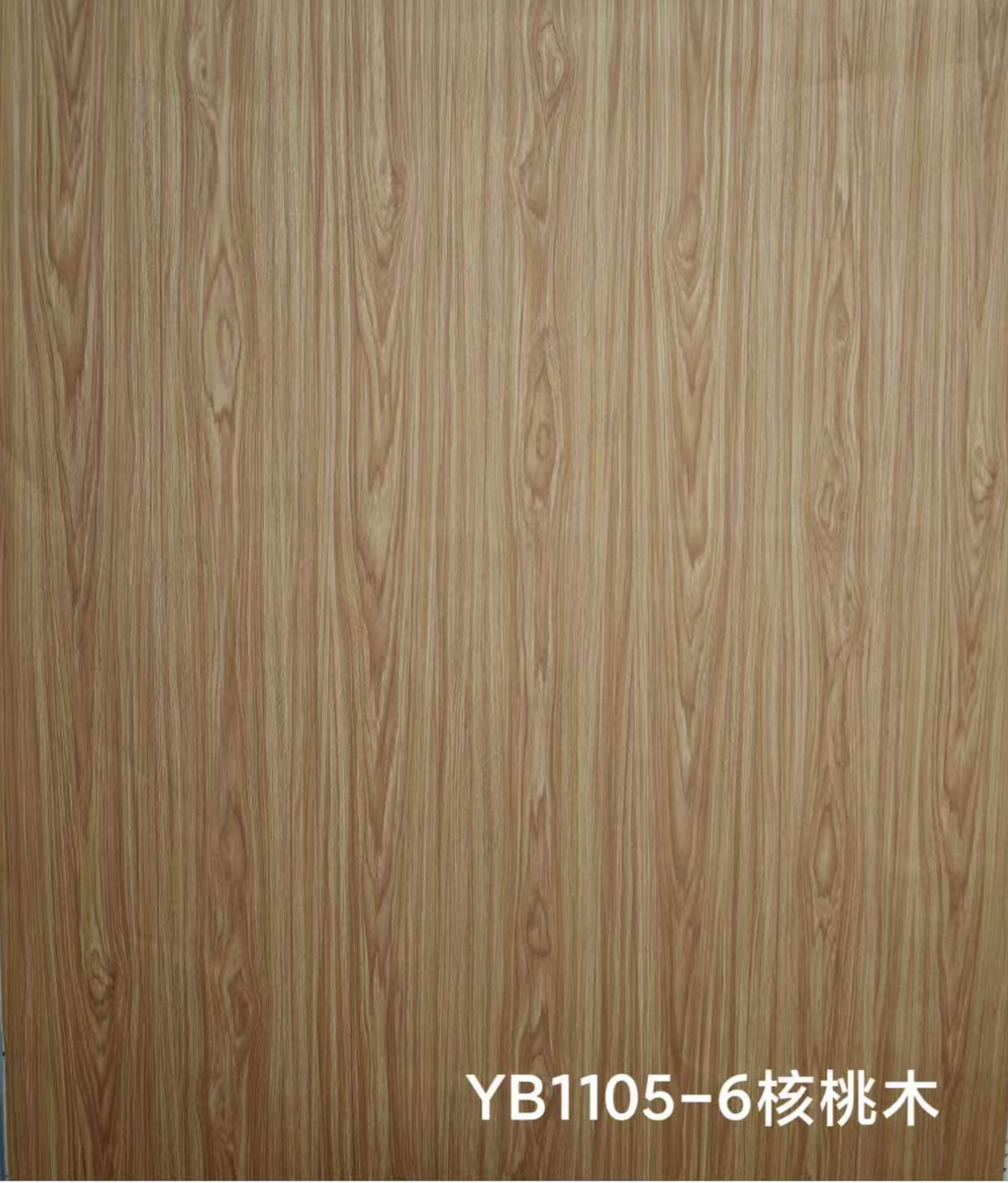 Melamine Paper YB1105-6 walnutYour email address will not be published. Required fields are marked.View Product →
Where Melamine Decorative Paper Ends Up
The material is versatile because it is pressed rather than glued. In practice it appears in four broad application groups.
- Melamine-faced boards, where the paper is pressed onto MDF, particleboard, or plywood that later becomes shelving, carcasses, and partitions.
- Furniture, including cabinets, wardrobes, desks, and retail fixtures that need a repeatable, easy-clean surface.
- Flooring, where a printed and impregnated overlay forms the visible wear layer of laminate planks.
- Doors, both as door skins on traditional cores and as the decorative face of WPC door panels and frames.
In our own factory the paper sits alongside PVC film as one of two surface options, which keeps us honest about how each material behaves under heat and pressure. If you would like a wider view of how these surfaces are used in finished interiors, our overview of the beauty and durability of melamine surfaces is a useful companion read.
Matching Colors and Woodgrains Across a Whole Project
Colour consistency is where a project either looks coherent or looks assembled from leftovers. A single build may require the same decor on a door skin, a frame, an architrave, and an edge strip, and each of those parts may be produced on a different machine at a different time. The decor code therefore matters more than the name of the tree. Ask for the same code across narrow and wide formats, and check whether a matching PVC film and edge banding exist before you commit.
Our own colour library leans heavily on natural woodgrains: oak, walnut, elm, maple, beech, teak, sapele, pear, apple, and technical wood, plus a smaller group of stone and abstract patterns. Wide formats naturally suit large faces such as wardrobe fronts and door skins, where a single sheet reduces visible joints. Decors such as our wide-sized 78042 pattern show how a broad format is intended to be used.
 Melamine Paper8043-1Your email address will not be published. Required fields are marked.View Product →
What to Check Before Placing an Order
Whether you are buying a trial roll or a full container, the checklist is short but worth following properly.
- Resin content and grammage per square metre, confirmed against the specification rather than an assumption.
- Colour consistency against an approved physical sample, not a screen image.
- Surface performance, including abrasion, scratching, staining, heat, and moisture resistance.
- Width, roll diameter, and winding direction matched to your press or wrapping line.
- Moisture content and packaging suitable for your climate and storage conditions.
- Samples, test reports, minimum order quantity, lead time, and shipping terms agreed in writing.
Two of these deserve extra attention. First, always approve a pressed sample rather than loose paper, because the final appearance depends on your press as much as on our coating. Second, store rolls in a dry, stable room; impregnated paper is forgiving, but it is not indifferent to humidity.
A Supplier Who Runs the Same Material on Its Own Lines
Hangzhou Lanyun New Materials, part of Yabo Decorative Materials Group, produces decorative surfaces and the products that use them. Our site covers more than 20,000 square metres with a 10,000 square metre factory, twelve or more WPC door extrusion lines, and ten coating lines, giving us annual capacity of 300,000 WPC doors and 150,000 melamine doors. That scale matters to buyers for one simple reason: we consume the same papers and films we sell, so the specification you receive has already been tested on a production line, not only in a sample room.
Quality control starts upstream, with supplier screening, incoming inspection, and batch comparison before material reaches a press. Delivery is planned through a full ERP system, with domestic orders typically shipped within 24 hours and export orders within a week. If you are sourcing melamine decorative paper for doors, furniture, or flooring, reach out to our team and tell us the decor, the format, and the volumes you have in mind.
Melamine decorative paper is a small part of a finished door or cabinet by weight and a large part of how it looks and lasts. Getting the format right, locking the decor code early, and verifying resin content before the first container leaves is usually the difference between a smooth project and an expensive correction. We are happy to help with any of those steps.


