


 English
 中文简体
 عربى

If you have ever watched a heavy timber gate drop a few millimetres after a season of rain and sun, you already know that the hinge is doing far more work than it gets credit for. On a garden gate or a driveway gate, the hinge is not a small accessory; it is the pivot the whole leaf depends on, and it absorbs a combination of weight, wind pressure and moisture movement that an interior door never sees. We build doors and supply the hardware that goes with them, so we spend a lot of time talking through exactly this question with gate makers, joiners and homeowners. Below is the same conversation in written form: what the hinge has to carry, which type suits which gate, how to size it, and how to fit it so the gate stays true for years rather than months.
Content
- 1 What Wooden Gate Door Hinges Really Have to Carry
- 2 The Main Hinge Types Used on Wooden Gates
- 3 Material Choice: Brass, Iron and the Weather Between Them
- 4 Sizing a Gate Hinge: Weight, Width and Hinge Count
- 5 Fitting Wooden Gate Door Hinges So the Gate Stays True
- 6 Small Habits That Keep Gate Hinges Working
- 7 A Short Buying Checklist Before You Order
- 8 Let Us Help You Match Hinge to Gate
What Wooden Gate Door Hinges Really Have to Carry
A gate leaf is a lever, and the hinge is the fulcrum at the short end. That geometry matters more than the raw weight on a spec sheet. A 900 mm wide leaf that weighs 25 kg puts noticeably more twisting force on its hinges than a 600 mm leaf of the same weight, because every gust of wind and every push at the latch edge is multiplied by the distance from the pivot. This is why a hinge that feels perfectly adequate on a bathroom door can fail in two winters on an exposed garden gate.
The second factor is moisture cycling. Solid timber and wood-plastic composite both expand and contract as humidity changes, and an outdoor gate swings through a much wider range than an internal door. A good hinge tolerates that movement without loosening its grip on the timber, which usually comes down to screw length, leaf thickness and how well the mortise was cut. The third factor is weather itself: rain, salt air and ultraviolet light attack the plating, the lubricant and the screw heads long before they attack the hinge body.
The Main Hinge Types Used on Wooden Gates
Most gate hinges fall into a handful of families, and the right choice usually follows from how the gate is built rather than from personal taste. A ledged and braced gate, for example, has a natural home for a strap hinge, while a framed gate with a clean stile face suits a butt hinge that disappears into the timber.
| Hinge type | Typical use | Load feel | What to watch |
|---|---|---|---|
| Standard butt hinge | Framed gates with flush stiles | Moderate | Needs an accurate mortise; both leaves show when open |
| Ball-bearing butt hinge | Heavier pedestrian gates | Higher | Smoother swing and less pin wear, but keep grit out |
| T-hinge or strap hinge | Ledged and braced timber gates | High | Spreads load across the boards; simple to re-tension |
| Adjustable or lift-off hinge | Gates that need seasonal tweaks | Moderate | Compensates for swelling; check the pin retention |
| Spring or self-closing hinge | Gates that must close behind you | Moderate to high | Set closing force carefully around children and pets |
Material Choice: Brass, Iron and the Weather Between Them
Brass has long been the quiet favourite for external gates. It resists rust, develops a warm patina rather than a scab of corrosion, and its bearing surfaces stay smooth without constant attention. A brass hinge costs more up front, but on a gate that will be opened several times a day for fifteen years, the cost per swing is modest. Our own 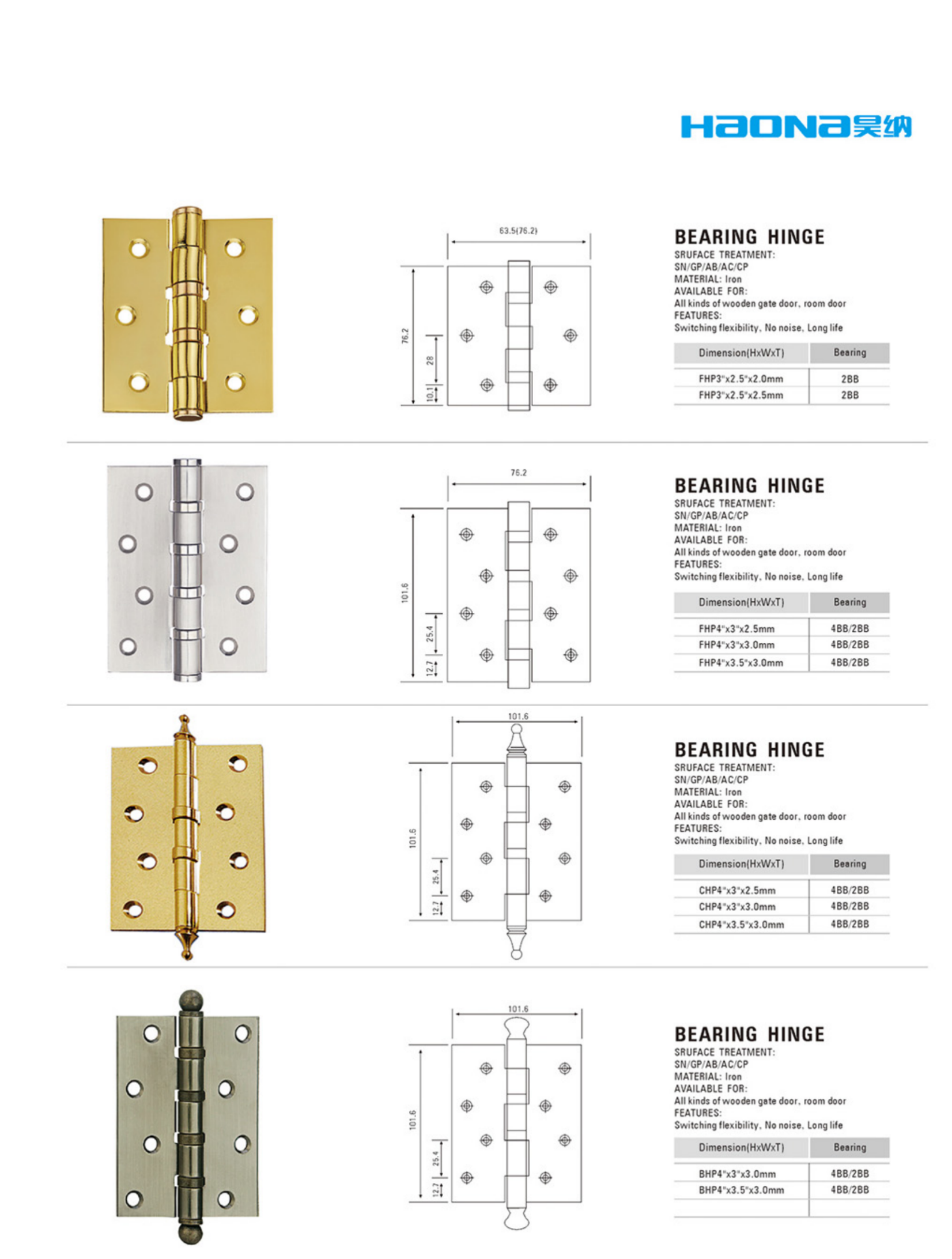 Custom Iron Hinge for Quiet CabinetryHigh-strength iron hinge with anti-rust coating and nylon bushings or ball bearings for quieter kitchen and bedroom cabinet doors.View Product → is the type of hinge we recommend when a client wants a gate that looks settled rather than newly installed.
Iron and steel hinges win on pure strength and price. They handle wide, heavy leaves well, particularly when the strap is long enough to spread the load over several boards. The trade-off is finish care: uncoated iron will bloom with rust in wet climates, so galvanised, powder-coated or regularly oiled versions are the sensible choice. We keep a straightforward 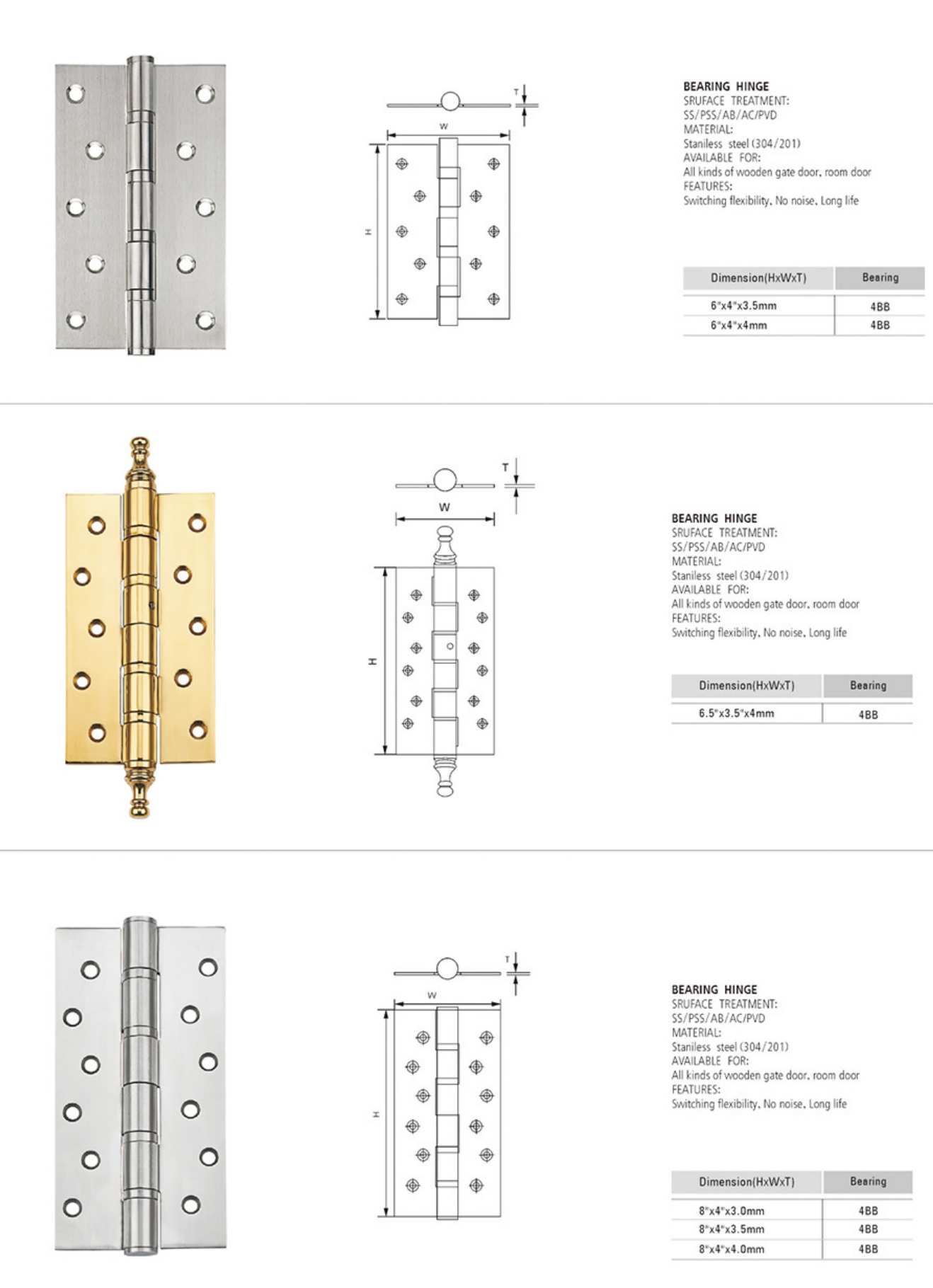 Custom Steel Hinge for Interior DoorsCold-rolled steel interior door hinge with satin nickel or polished chrome finishes, lubricated pins and standardized hole patterns for smooth door alignment.View Product → in our components range for exactly this kind of practical, budget-conscious project.
Whichever metal you pick, match the screw and the finish to it. Mixing stainless screws into a brass hinge is fine and often wise, but plain steel screws into any outdoor hinge is a shortcut that shows up as a rusty streak within a year.
Sizing a Gate Hinge: Weight, Width and Hinge Count
Hinge ratings are usually quoted per pair, not per hinge, and that distinction trips up a lot of first-time buyers. A pair rated for 40 kg is not the same as two hinges each rated for 40 kg. Read the label as a pair, then add a margin of roughly a third for wind and moisture before you commit.
- Light pedestrian gates up to about 900 mm wide and 1.2 m high generally work on two hinges.
- Anything taller, wider or visibly heavier benefits from a third hinge set at the midpoint.
- Driveway leaves above roughly 40 to 50 kg should be planned around four hinges or a purpose-made heavy-duty set.
- Keep the top hinge about 150 to 200 mm below the top edge and the bottom hinge the same distance above the bottom edge to reduce rocking.
- Choose screws long enough to bite into solid timber, usually around two and a half times the thickness of the hinge leaf.
Fitting Wooden Gate Door Hinges So the Gate Stays True
Most hinge problems we hear about are installation problems rather than product problems. A gate that binds, drops or swings open on its own was usually hung on a post that was not plumb, or mortised a millimetre too deep on one side.
- Check the post for plumb and the gate for square before you cut anything. Correcting a leaning post afterwards is far more work than fixing it first.
- Wedge the gate in its final position with a 2 to 3 mm gap at the latch side and 5 to 8 mm of ground clearance, then mark the hinge positions directly from the hinge leaves.
- Score the outline with a sharp knife and cut the mortise to the exact leaf thickness so the hinge sits flush, never proud and never sunk.
- Drill pilot holes for every screw. Hardwood and composite both split easily, and a split stile will not hold a hinge no matter how good the screw is.
- Fix the top hinge first, test the swing, then set the bottom hinge, and finally the middle one if you are using three.
- Swing the gate through its full arc before final tightening and adjust the mortise depth rather than bending the hinge.
Small Habits That Keep Gate Hinges Working
A minute of attention twice a year is usually all it takes. Apply a light lubricant to the pin or bearing surface at the start of the wet season and again in dry weather, and wipe away grit before it works into the joint. Walk around with a screwdriver once a year and check that every fixing is still snug, because a slightly loose screw allows movement, and movement is what ovalises the hole. If you notice black streaks on brass or white bloom on coated iron, clean and re-oil rather than waiting for the surface to pit. And if the gate starts to catch on the ground after a wet month, check the hinge screws before you plane anything; seasonal swelling often resolves itself.
A Short Buying Checklist Before You Order
Before you choose a hinge, write down the leaf weight, the leaf width, the stile thickness and the climate the gate will live in. Those four numbers will narrow the field faster than any catalogue photo.
- Confirm the rating is per pair and add a margin for wind and moisture.
- Check that the correct fixings are included, or buy them at the same time.
- Match the finish to your other gate hardware so the gate reads as one piece.
- Order one spare hinge of the same model; matching a discontinued finish later is difficult.
- Read the installation guidance before cutting timber, not after.
If you would like to weigh up specific hinge patterns in more detail, our guide to picking the right gate hinges walks through the same choices with a little more depth.
Let Us Help You Match Hinge to Gate
We supply hinges as part of a wider door hardware range, alongside frames, panels and finished doors, so we are used to matching hardware to the way a leaf is actually built. If you are specifying hinges for a batch of gates or for doors that will sit alongside them, send us the leaf dimensions and the environment, and we will suggest a sensible pairing rather than the most expensive option. You can reach the team through our contact page, and we will usually come back with a recommendation and a sample list within one working day.


