


 English
 中文简体
中文简体
 عربى
عربى

Content
- 1 What Is a WPC Carved Door and Why Is It Gaining So Much Attention
- 2 WPC Carved Door vs. Solid Wood Door: A Practical Comparison
- 3 Popular WPC Carved Door Styles and Design Categories
- 4 Core Material Structures: What's Actually Inside a WPC Carved Door
- 5 Standard Sizes and Custom Dimensions for WPC Carved Doors
- 6 Surface Finishes and Color Options for WPC Carved Doors
- 7 How to Assess Quality When Buying a WPC Carved Door
- 8 Installation Tips for WPC Carved Doors
- 9 Maintaining a WPC Carved Door to Keep It Looking New
- 10 Where WPC Carved Doors Work Best: Matching the Right Door to Each Room
What Is a WPC Carved Door and Why Is It Gaining So Much Attention
A WPC carved door is a door made from wood-plastic composite (WPC) material that features decorative relief carvings, embossed patterns, or three-dimensional surface designs pressed or machined directly into the door panel. WPC itself is an engineered material made by combining wood fiber or wood flour — typically recycled sawdust or agricultural residues — with thermoplastics such as PVC, PE, or PP, along with stabilizers, UV inhibitors, and processing additives. The result is a material that looks convincingly like natural wood, behaves more predictably, and holds up significantly better in challenging environments.
The carved or embossed surface of a WPC door adds a layer of visual richness that plain flush doors simply cannot offer. Designs range from clean geometric patterns and subtle linear textures to elaborate floral motifs, traditional Chinese lattice panels, European classical moldings, and contemporary abstract relief work. Because WPC can be molded or machined with high precision, the carving detail on a quality WPC carved door is often sharper and more consistent than hand-carved solid wood — and unlike solid wood, it won't crack, split, or warp over time as humidity changes.
The growing interest in WPC carved doors comes down to a combination of practical advantages and aesthetic versatility. Architects, interior designers, and homeowners are discovering that they can achieve a high-end, customized look without the cost, maintenance demands, or environmental concerns associated with premium hardwood doors. This has made WPC carved doors increasingly common not just in residential projects but also in hotels, commercial offices, schools, and healthcare facilities where durability and appearance both matter.
WPC Carved Door vs. Solid Wood Door: A Practical Comparison
The most common question buyers ask is how a WPC carved door actually stacks up against a traditional solid wood door. The honest answer depends on what you prioritize — but for most residential and commercial applications, WPC wins on several key dimensions.
| Feature | WPC Carved Door | Solid Wood Door |
| Moisture Resistance | Excellent — does not swell or warp | Poor to moderate — swells with humidity changes |
| Dimensional Stability | Very high — consistent year-round | Variable — expands and contracts seasonally |
| Carving Consistency | Uniform and precise across production | Hand-carved variation; premium cost |
| Insect and Termite Resistance | Naturally resistant | Vulnerable without treatment |
| Maintenance Required | Minimal — wipe clean, no refinishing | Periodic sanding, staining, or sealing |
| Cost | Moderate — more affordable than premium hardwood | High — especially for carved hardwood |
| Environmental Impact | Lower — uses recycled wood fiber | Higher — requires virgin timber |
| Sound Insulation | Good — depends on core design | Good to excellent — solid mass |
The one area where solid wood still holds an edge is in the tactile authenticity of genuine grain and the acoustic mass of a truly solid panel. For applications where budget is generous and the door will be carefully maintained, solid hardwood carved doors remain exceptional. But for bathrooms, kitchens, exterior-facing entrances in humid climates, or any situation where long-term stability and minimal maintenance matter more than material purism, WPC carved doors are the more practical choice.
Popular WPC Carved Door Styles and Design Categories
One of the most compelling aspects of WPC carved doors is the sheer breadth of available design styles. Manufacturers can produce consistent, repeatable carving patterns across large production runs, making it possible to offer a wide design catalog at accessible price points. Understanding the main style categories helps you narrow down what fits your space.
Traditional and Classical Designs
Traditional WPC carved door panels draw from European classical architecture and Asian decorative arts. European classical designs typically feature raised panel layouts, dentil molding borders, fluted columns, acanthus leaf carvings, and symmetrical geometric arrangements derived from Baroque, Georgian, or Victorian design language. These doors work beautifully in formal living rooms, master bedrooms, and entrance halls where a sense of heritage and richness is desired. Asian classical designs — particularly those drawing from Chinese furniture traditions — feature lattice screen patterns, cloud scroll motifs, plum blossom reliefs, and interlocking geometric borders that create a layered, sophisticated visual depth.
Modern and Contemporary Designs
Contemporary WPC carved doors favor clean lines, restrained surface texture, and geometric precision over elaborate ornamentation. Linear groove patterns, subtle wave reliefs, minimalist raised bars, and abstract panel divisions are common. These designs integrate naturally with modern interior architecture — flat-front cabinetry, polished concrete floors, neutral palettes, and frameless glazing. They deliver visual interest without visual clutter, making them particularly effective in open-plan spaces where the door needs presence without competing with the surrounding design.
Nature-Inspired and Floral Designs
Floral and botanical carving patterns remain consistently popular for residential interiors, particularly in bedrooms, children's rooms, and spaces designed around a natural or organic aesthetic. Common motifs include roses, peonies, lotuses, bamboo, vines, and tree branch arrangements. These designs tend to work best when paired with warm, natural tones — walnut, oak, or teak-effect WPC finishes — and with interior color schemes that include earthy greens, warm neutrals, or soft terracottas.
Combination Panel Designs
Many WPC carved door designs combine carved lower panels with glass inserts, louver sections, or contrasting flat panels in the upper portion. This approach adds visual variety to the door face while also allowing light transmission between rooms — useful in interior applications where natural light distribution is a design goal. The carved sections provide visual richness and privacy, while the glass or open sections maintain an airy, connected feeling.
Core Material Structures: What's Actually Inside a WPC Carved Door
Not all WPC carved doors are constructed the same way, and the internal structure has a significant effect on performance characteristics like weight, acoustic insulation, thermal insulation, and long-term rigidity. When comparing products, understanding what's inside the door panel is just as important as evaluating the surface design.
- Solid WPC core: The entire panel is extruded or compression-molded WPC material. This construction offers maximum rigidity, excellent sound damping, and the best moisture resistance throughout the cross-section. Solid WPC doors are heavier than hollow-core alternatives but are significantly more durable and better suited for exterior or high-traffic applications.
- WPC skin over honeycomb or foam core: A WPC face panel is bonded over a lightweight internal structure — either a paper honeycomb grid or a rigid foam (typically polyurethane or polystyrene) core. This reduces overall door weight considerably while maintaining a high-quality surface. The trade-off is slightly reduced acoustic mass and lower impact resistance in the door body compared to solid WPC construction.
- WPC skin over timber frame: A WPC decorative skin is applied over a timber or MDF frame. This approach gives a solid-feeling door with a WPC exterior that resists surface moisture and wear. The internal timber frame, however, remains susceptible to moisture ingress if edge sealing is inadequate — a factor to watch for in bathroom or exterior applications.
- Full WPC profile with hollow chambers: The door profile is extruded as a single WPC piece with internal hollow chambers — similar in concept to uPVC window profiles. The chambers add structural rigidity while keeping weight manageable and provide a modest degree of thermal break performance.
For bathroom and kitchen interior doors, a WPC skin over foam core construction offers an excellent balance of light weight and moisture resistance. For front entrance doors or heavily trafficked internal doors, solid WPC or WPC over timber frame with fully sealed edges is the more appropriate choice.
Standard Sizes and Custom Dimensions for WPC Carved Doors
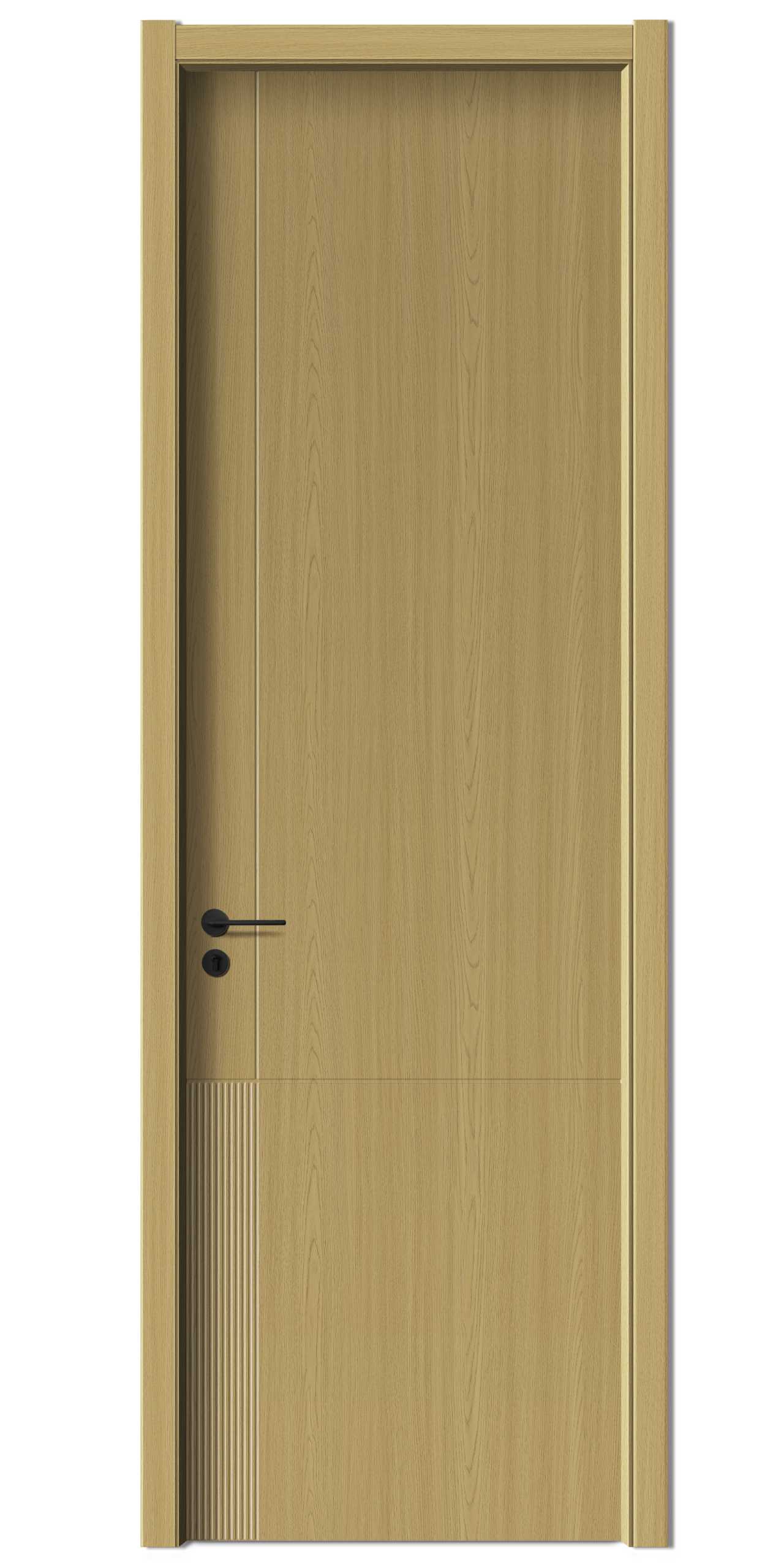
WPC carved doors are available in a range of standard sizes that suit most residential and light commercial openings. Knowing the standard dimensions helps you plan rough opening sizes during construction or renovation, and identify when a custom-sized door will be necessary.
| Application | Common Width | Common Height | Typical Thickness |
| Bedroom / Interior Room | 800–900mm | 2000–2100mm | 40–45mm |
| Bathroom / Toilet | 700–800mm | 2000–2100mm | 35–40mm |
| Main Entrance / Front Door | 900–1000mm | 2100–2400mm | 45–50mm |
| Double Door / Grand Entrance | 1400–1800mm (pair) | 2100–2400mm | 45–50mm |
| Sliding / Pocket Door | 600–900mm per leaf | 2000–2400mm | 35–40mm |
Most WPC door manufacturers offer custom sizing with a lead time of two to four weeks, which is considerably faster than custom-carved solid wood doors that may take months. If your project involves non-standard ceiling heights, unusually wide openings, or heritage building proportions, confirm custom size availability and any minimum order quantities with your supplier before finalizing the design brief.
Surface Finishes and Color Options for WPC Carved Doors
The surface finish of a WPC carved door determines both its visual character and its practical durability. WPC doors are available in a wide range of finish types, each with distinct aesthetic and maintenance characteristics.
- Wood grain transfer film (PVC or melamine foil): A decorative film laminated over the WPC substrate, printed with highly realistic wood grain patterns. Available in dozens of species simulations — oak, walnut, teak, cherry, pine, and more — as well as solid colors and stone-effect prints. This is the most common finish type and offers an excellent balance of realism, scratch resistance, and cost.
- UV-cured paint finish: A factory-applied paint system cured under ultraviolet light, creating a hard, durable surface film. UV-cured paint finishes are available in virtually any RAL or custom color, offer superior resistance to fading and yellowing, and provide a consistently smooth or lightly textured surface. They are commonly specified for contemporary designs where solid color or matte finishes are preferred over wood simulation.
- High-gloss lacquer: A glossy, reflective finish applied over the WPC surface. Popular for modern and European-style interiors, high-gloss finishes make spaces feel larger and more light-filled. The trade-off is that fingerprints, light scratches, and surface imperfections are more visible than on matte finishes.
- Co-extruded color WPC: The color pigment is integrated throughout the WPC material during extrusion rather than applied as a surface coating. This means that minor surface scratches don't reveal a different-colored substrate underneath — particularly useful for high-traffic areas or exterior applications where surface damage is more likely.
How to Assess Quality When Buying a WPC Carved Door
The WPC door market includes a wide spectrum of quality levels, and the price difference between a well-made and a poorly made WPC carved door isn't always obvious from photos or descriptions alone. Knowing what to look for — both in product specifications and physical inspection — helps you make a confident purchasing decision.
Check the WPC Formulation and Density
Higher-quality WPC doors use a balanced formulation with adequate stabilizer content and proper wood-fiber-to-plastic ratios, typically achieving a panel density of 0.7–1.1 g/cm³. Doors that feel surprisingly light for their size may have a higher void content or lower-quality filler materials that compromise structural integrity and acoustic performance. Ask suppliers for technical data sheets that specify material density, bending strength (MOR), and modulus of elasticity (MOE) if you're comparing products for a demanding application.
Examine the Carving Depth and Edge Sharpness
Quality WPC carved doors feature crisp, well-defined carving relief with consistent depth across the panel. Run your hand across the carved surface — the transitions between raised and recessed areas should feel sharp and clean, not rounded or blurred. Soft, indistinct carving edges often indicate low-pressure molding or lower-quality tooling. Also check that the carving pattern is centered and symmetrical on the panel, with consistent proportions relative to the door dimensions.
Inspect the Surface Film Adhesion and Finish Quality
On film-laminated doors, press firmly on the surface near corners and edges — any delamination or bubbling indicates poor adhesive application or inadequate pressing during manufacturing. Check the finish on carved recesses particularly carefully, as this is where surface film application is most technically demanding. Poorly applied film in recessed areas peels earliest and is the most common early quality failure on budget WPC doors.
Verify the Door Frame and Hardware Compatibility
A WPC carved door should come with a matching WPC door frame set or be clearly specified to work with standard timber or steel frames. Check that the door frame includes a proper weather seal channel for exterior applications, that hinge positions are pre-machined to standard spacing, and that the lock mortise is compatible with your preferred lockset. Mismatched hardware and frame systems are a common source of installation problems that add cost and delay.
Installation Tips for WPC Carved Doors
WPC carved doors are generally straightforward to install using standard door-hanging techniques, but there are a few specific considerations related to the material and panel construction that are worth knowing before you start.
- Allow the door to acclimatize: Even though WPC is far more dimensionally stable than solid wood, bring the door into the installation environment 24–48 hours before hanging, particularly if moving from a cold warehouse to a heated interior space. This allows any minor thermal expansion to stabilize before you fit the frame.
- Use appropriate fixings for WPC: WPC material holds screws differently from timber — it has good holding strength for correctly sized screws but can crack if screws are overtightened or positioned too close to edges. Pre-drill pilot holes for hinge and lockset screws and use coarse-thread screws rated for plastic composite materials for the best holding performance.
- Check and level the frame before hanging: WPC doors don't flex to compensate for an out-of-square frame the way solid timber sometimes can. Ensure the door frame is plumb, square, and level before hanging the door — any frame twist will immediately show as uneven gaps around the door leaf.
- Seal all cut edges: If the door is trimmed to fit on site, seal the exposed cut edges immediately with an appropriate WPC edge sealant or matching silicone. Cut edges expose the internal core to potential moisture ingress — particularly important in bathroom installations.
- Use quality hinges rated for the door weight: WPC doors, especially solid-core versions, can be heavier than equivalent hollow-core doors. Use commercial-grade butt hinges or concealed hinges rated for the actual door weight, and install three hinges rather than two for doors over 35 kg to prevent long-term sag and binding.
Maintaining a WPC Carved Door to Keep It Looking New
One of the practical advantages of WPC carved doors over solid wood is that maintenance is minimal and straightforward. There's no periodic sanding, staining, varnishing, or sealing required. Day-to-day care is simple enough that it doesn't require specialist products or professional help.
- Regular cleaning: Wipe the door surface with a soft, damp cloth and a mild detergent or all-purpose cleaner. For carved recesses where dust and grime accumulate, use a soft-bristle brush — an old toothbrush works well — to clean out the relief detail without scratching the finish.
- Avoid abrasive cleaners: Steel wool, abrasive scrubbing pads, and solvent-based cleaners can damage the surface film or painted finish on WPC doors. Stick to pH-neutral, non-abrasive cleaning products and soft cloths.
- Address minor scratches promptly: Small surface scratches on film-laminated WPC doors can be touched up with matching wood-effect touch-up markers available from most door suppliers. On painted WPC doors, a small amount of matching touch-up paint applied with a fine brush will conceal minor damage before it has a chance to become a larger problem.
- Check and maintain door hardware annually: Even if the door panel itself is maintenance-free, the hinges, locks, and closers need periodic attention. Lubricate hinges with a light machine oil or silicone spray, check that lock mortise components move freely, and adjust the door closer tension if the door is closing too fast or too slowly.
- Inspect seals on exterior doors seasonally: Weather seals around the door perimeter can compress and lose effectiveness over time. Check seals before the wet season each year and replace them if they're cracked, flattened, or no longer making consistent contact with the door leaf when closed.
Where WPC Carved Doors Work Best: Matching the Right Door to Each Room
WPC carved doors are versatile enough to be used throughout a building, but some applications suit the material's properties especially well. Matching the door specification to the room's environmental conditions and usage pattern ensures you get the full benefit of what WPC has to offer.
- Bathrooms and wet rooms: This is where WPC carved doors genuinely shine compared to solid timber. The material's inherent moisture resistance means bathroom doors stay dimensionally stable even in daily steam exposure, eliminating the sticking, warping, and paint peeling that plagues timber bathroom doors in humid climates.
- Master bedroom and living room entrances: WPC carved doors with traditional or classical panel designs create elegant focal points in formal rooms without the premium price of hand-carved hardwood alternatives. The detailed relief work adds visual depth that flat flush doors can't match.
- Hotel guest rooms and corridors: The combination of durability, consistent appearance across large quantities, and minimal maintenance makes WPC carved doors a practical choice for hospitality projects. A carved WPC door creates a stronger first impression when a guest enters their room than a plain flush alternative.
- School and healthcare facilities: High-traffic environments benefit from WPC's impact resistance and easy-clean surface properties. Carved panels add visual interest to institutional corridors that would otherwise feel clinical and unwelcoming.
- Coastal and humid climate homes: In regions with high ambient humidity or salt-laden air, WPC carved doors resist the moisture absorption and surface degradation that rapidly degrade both solid timber and MDF-core alternatives. This makes them a particularly smart investment in tropical, coastal, or monsoon-climate construction.


