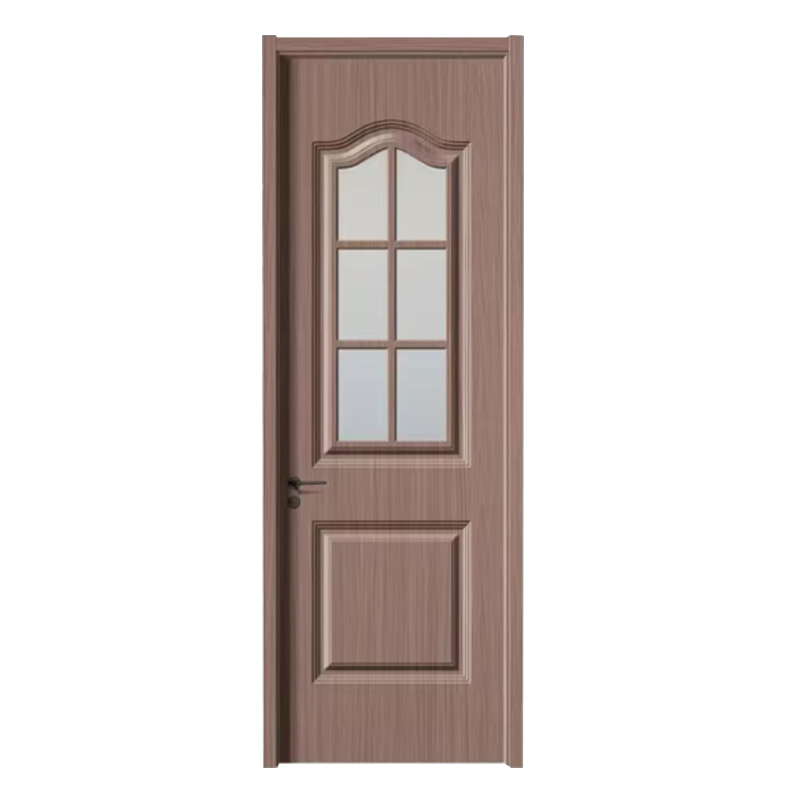
Hangzhou Lanyun New Materials Co., Ltd. designs, develops and manufactures WPC doors from its base in Lin'an District, Hangzhou, China. Within the COMPLETE DOOR family, the WPC Glass Door range pairs tempered glazing with a wood-plastic composite shutter, giving project teams a door that admits daylight, controls sound and resists moisture without the maintenance profile of solid timber.
We supply this range to distributors, contractors, hospitality developers and interior fit-out specialists who need a repeatable door specification across many openings, with the frame, architrave, hardware and finish coordinated from one production source.
What the WPC Glass Door Range Covers
The glass door is the glazed member of our complete-door programme. The shutter is built on an extruded WPC core, and the glazed aperture is set with tempered glass so the leaf carries light through interior partitions, corridors, stairwells and bathroom or utility zones where a solid leaf would darken the space.
Because the leaf, frame and trim come from the same material system, the door reads as one assembly rather than a composite of mismatched parts. That consistency matters on multi-floor projects where hundreds of openings must look and behave alike.
| Element |
Standard approach |
Project options |
| Door leaf core |
Extruded WPC shutter |
Panel profile, leaf thickness, edge detail |
| Glazing |
Tempered glass panel |
Glass size, pattern, optional UV-resistant coating |
| Surface finish |
Coated or film-laminated face |
Colour, woodgrain or solid decor, gloss level |
| Frame and architrave |
Matching WPC frame system |
Wall thickness, rebate, architrave profile |
| Hardware |
Lock, hinge and sealing strip set |
Latch type, hinge finish, acoustic seal |
Where Glazed WPC Doors Fit
Glass changes the job a door does. A glazed WPC leaf is specified where borrowed light, visual supervision or a lighter architectural line is required, while the composite core keeps the door stable in humid or frequently cleaned environments.
- Residential interiors: bathroom, kitchen and corridor doors that need daylight and privacy in one leaf.
- Hospitality and serviced apartments: guest-room and back-of-house doors where a consistent glazed language runs through the building.
- Offices and clinics: partition doors that keep sightlines open while the WPC core reduces sound transmission between rooms.
- Retail and mixed-use fit-out: repeated glazed openings that must match a finish schedule across floors.
The range sits alongside our solid-leaf options. Where a project mixes glazed and solid doors, the WPC Flat Door and WPC Carved Door lines can be finished to the same decor so the glazed and solid leaves sit together without visual conflict.
Material and Performance Considerations
WPC combines wood-derived material with polymer, producing a shutter that resists moisture, deformation and the swelling behaviour associated with untreated timber. For glazed doors this stability is important: the leaf must hold the glass aperture true through changes in humidity and temperature.
Glazing and safety
We set tempered glass in the glazed aperture. Tempered glass is specified for its strength and safer breakage pattern compared with annealed glass. Glass area, edge clearance and retention detail are agreed at configuration stage so the leaf and glazing work as one unit.
Light, privacy and heat
Glass panels admit natural light and reduce reliance on artificial lighting. Where solar exposure is a concern, the tempered glass can be supplied with a UV-resistant coating that limits ultraviolet transmission, helping protect interior finishes and reduce heat gain. Privacy can be balanced through glass pattern, frosting or panel proportion.
Acoustics and maintenance
The WPC core contributes sound insulation, making glazed leaves suitable for rooms that need a quieter boundary. Both the composite face and the glass are smooth and easy to clean, which suits bathrooms, clinics and other regularly washed areas.
Configuration Choices for a Project Schedule
A glazed door schedule is only repeatable when every variable is fixed before production. We work through the following points with each customer so the quotation and the finished doors match the drawing set.
Leaf and opening
Clear opening width and height, leaf thickness, handing, and whether the door is single or paired.
Glass layout
Glazed area, position within the leaf, glass pattern or coating, and privacy requirement.
Finish and frame
Surface decor, colour, gloss level, frame profile and architrave detail.
Hardware set
Lock type, hinge specification, sealing strip and any access or closing requirement.
Hardware is drawn from our OTHER COMPONENTS range, so locks, hinges and sealing strips are matched to the door rather than sourced separately. Surface decor can be coordinated with our PVC film and melamine paper programmes when a project needs a specific colour or grain.
Manufacturing Capacity and Supply Reliability
Our production base covers more than 20,000 square metres, with a factory area of 10,000 square metres. More than 12 WPC door extrusion lines and 10 coating lines support an annual capacity of 300,000 sets of WPC doors and 150,000 sets of melamine wooden doors.
That capacity is managed through an ERP system and a structured sales and storage network. Raw-material supply is controlled through supplier screening, incoming material testing and comparison, which underpins consistent quality and stable pricing across repeat orders.
- Extrusion and coating lines configured for continuous door production.
- Incoming material inspection before release to production.
- Order handling through ERP for traceable scheduling and dispatch.
Quality Assurance and Acceptance
Quality control begins with raw materials and continues through extrusion, coating, glazing and hardware fitting. Each stage is checked against the agreed specification before the door is packed.
| Stage |
What is checked |
| Incoming material |
Supplier audit, material testing and comparison against approved reference |
| Extrusion |
Profile dimensions, surface condition and leaf flatness |
| Coating and finish |
Colour match, adhesion and visual uniformity |
| Glazing and hardware |
Glass fit and retention, hinge and lock alignment, seal continuity |
| Final inspection |
Overall appearance, operation and packing condition |
Acceptance criteria are agreed with the customer at order stage, and inspection records are kept against the order file. Where a project requires specific test evidence, the requirement is confirmed before production so the correct documentation accompanies the shipment.
Customisation, Packaging and Delivery
We develop and produce doors according to drawings or samples supplied by the customer. Custom work covers leaf size, glazed area, surface decor, frame profile and hardware selection, with samples used to confirm finish and construction before a production run.
Doors are packed for transport with protection on faces, edges and glazed areas. Packing format, labelling and pallet or carton arrangement are agreed with the order so that site handling and storage are straightforward.
- Production to customer drawings or physical samples.
- Finish and construction samples for approval before bulk production.
- Order-specific packing and labelling for distribution or direct-to-site delivery.
Information We Use to Configure Your Solution
A precise quotation depends on a small set of project inputs. When these are clear, we can confirm the leaf build, glazing, finish and hardware and issue a proposal that matches the schedule.
- Door schedule with opening sizes, quantities and handing.
- Wall thickness and frame fixing condition.
- Glazing requirement: glass area, pattern, privacy and any UV coating.
- Finish reference: colour, grain, gloss level or a physical sample.
- Hardware preference: lock, hinge and sealing strip.
- Delivery destination, packing preference and required documentation.
With those details we prepare a configuration and quotation that reflects the actual production scope, not a generic price list. The Classic Elegant WPC Glass Door shows the glazed construction in a finished configuration.
Frequently Asked Questions
What is a WPC glass door made of?
The leaf is built on an extruded wood-plastic composite core, and the glazed aperture is set with tempered glass. The frame and architrave use the same WPC material system, and the surface is finished with a coating or decorative film.
Can the glass be supplied with UV protection?
Yes. The tempered glass can be treated with a UV-resistant coating that limits ultraviolet transmission, helping reduce indoor heat gain and protect interior finishes from fading. This is confirmed at configuration stage.
Do you produce doors to custom sizes and finishes?
We develop and produce according to customer drawings or samples. Leaf size, glazed area, surface decor, frame profile and hardware can all be set to the project schedule, with samples approved before bulk production.
How are the doors packed for export?
Doors are packed with protection on faces, edges and glazed areas. Packing format, labelling and pallet or carton arrangement are agreed per order to suit distribution or direct-to-site delivery.
What is the production capacity behind this range?
Our facility covers more than 20,000 square metres and runs over 12 WPC door extrusion lines and 10 coating lines, with annual capacity of 300,000 sets of WPC doors and 150,000 sets of melamine wooden doors.
Can glazed and solid doors be supplied in the same finish?
Yes. The WPC Glass Door, WPC Flat Door and WPC Carved Door lines can be finished to a common decor so mixed glazed and solid schedules read as one architectural family.



 English
 中文简体
 عربى