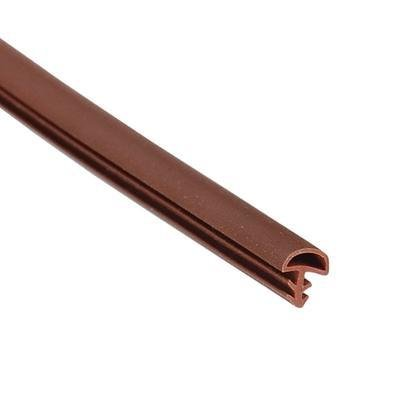
Hangzhou Lanyun New Materials Co., Ltd. builds WPC door systems, and the Sealing Strip belongs to the component set that closes the gap between leaf, frame and architrave. We supply sealing strips as a matched accessory to our COMPLETE DOOR range and as a standalone component order for door factories and project packagers.
Because the strip is produced and specified alongside the door profiles it seats into, the fit, colour and compression behaviour are resolved at the same time as the door configuration rather than after it.
What the Sealing Strip Does in a WPC Door Assembly
A sealing strip is the compressible element that runs around the door perimeter and against the frame rebate. In a WPC door it performs three jobs at once: it interrupts the air path to reduce draught and sound transfer, it buffers the leaf against the stop to limit rattle and slamming impact, and it keeps dust and moisture-bearing air away from the closing line.
The strip is a small line item with a disproportionate effect on how a finished door is judged. A door that closes with a soft, even resistance and no light gap reads as a better product than an identical leaf with a poorly seated seal.
Where the Strip Sits in Our Product Range
Sealing strips are grouped with locks and hinges under OTHER COMPONENTS, the hardware and finishing layer that turns panels and frames into a working door. The table below shows how the component range maps onto door types and what each part contributes to the finished assembly.
| Component |
Function in the door |
Typical door types |
Selection focus |
| Sealing strip |
Perimeter seal at leaf and frame rebate |
Flat, carved, assemble and glass doors |
Profile geometry, compression, colour match |
| Hinge |
Load-bearing pivot between leaf and frame |
All hinged door types |
Leaf weight, routing position, finish |
| Lock |
Latching, privacy and security |
Interior and entrance sets |
Backset, faceplate, handing |
| WPC Door Frame |
Rebate that receives the seal and the leaf |
All door types |
Rebate depth, stop position, wall thickness |
Application Fit Across Door Types
The same sealing strip family serves different door constructions with different demands on the seal. We match the strip to the leaf type and the room condition rather than issuing one universal profile.
- Flat doors — a straight, uninterrupted rebate gives the most predictable compression; the strip can run as a continuous perimeter loop with mitred or butted corners.
- Carved doors — deeper relief near the leaf edge can interrupt the seal line, so the strip position is set against the actual carved profile.
- Assemble doors — seals are supplied with the matched part set so the frame, shutter and architrave arrive with the correct strip length and profile.
- Glass doors — the glazed aperture changes leaf weight and stiffness, which affects how much closing force the seal should add.
Critical Specifications We Confirm
Sealing performance is decided by a small number of dimensional and material variables. These are the parameters we settle before a strip goes into production.
Profile geometry
Cross-section, leg height and bulb shape must seat into the frame rebate without bottoming out before the leaf contacts the stop.
Compression range
The working compression band determines closing force and how long the seal keeps its recovery after repeated cycling.
Colour and finish
Strip colour is aligned with the leaf decor and frame finish so the seal line disappears when the door is closed.
Fixing method
Self-adhesive backing, kerf insertion or channel retention, chosen to suit the frame machining already in use.
Manufacturing Base and Supply Reliability
Lanyun operates a production facility of more than 20,000 square meters with a 10,000 square meter factory area, running over 12 WPC door extrusion lines and 10 coating lines. Annual capacity reaches 300,000 sets of WPC doors and 150,000 sets of melamine wooden doors.
That scale matters for sealing strips because the component is consumed at the same rate as the doors it fits. Strip supply is planned against the door programme, so a repeat order does not become a bottleneck at the packing stage.
Incoming material control follows defined screening and auditing of raw material suppliers, incoming material testing and comparison before release to production. For a seal, that means the compound and the profile are checked before they reach the assembly line.
Customisation and Configuration Options
We develop and produce components to customer drawings or samples. For sealing strips this covers profile development to match a frame rebate, colour matching to a decor, and length or coil format suited to the packing method.
- Profile drawn to the customer's rebate section or reverse-engineered from a physical sample.
- Cut lengths matched to door height, with corner treatment agreed for the perimeter run.
- Coil or straight-length supply depending on whether the strip is applied in the factory or on site.
- Strip supplied loose, bagged with the hardware kit, or pre-fitted to the frame before packing.
Quality Checks and Acceptance
Sealing strips are checked against the agreed drawing before dispatch. The checks below are the ones that most directly affect how the strip behaves once the door is hung.
| Check |
What is verified |
Why it matters on site |
| Section dimensions |
Profile against approved drawing |
Prevents gaps or over-compression at the rebate |
| Colour consistency |
Batch-to-batch match to the approved sample |
Keeps the seal line visually neutral |
| Adhesion or retention |
Backing grip or kerf hold |
Stops the strip lifting during transport and use |
| Length and count |
Cut length and quantity per carton |
Keeps packing kits complete per door set |
Packing, Documentation and Delivery Scope
Sealing strips are packed to survive compression and handling in transit, with carton quantities set to the door programme so a packer can draw a complete kit without counting. Where the strip ships with a door order, it is consolidated with the frame and hardware so the set arrives together.
Order documentation covers the approved profile drawing, colour reference and packing list. Our ERP system and distribution network support order tracking from confirmation through dispatch, and our after-sales team, built from technical staff, follows up on fit and installation questions after delivery.
Information We Use to Configure Your Solution
A sealing strip quotation is only as good as the interface data behind it. We prepare the configuration and price from the following inputs.
- Frame rebate drawing or a physical frame sample, with the stop position marked.
- Door type and leaf thickness, plus leaf weight for glazed or carved variants.
- Required compression feel — light closing for interior sets, firmer contact for acoustic or exterior-facing doors.
- Colour reference matched to the leaf decor or frame finish.
- Fixing preference: adhesive backing, kerf insertion or channel retention.
- Supply format and annual or per-shipment quantity, so strip output is planned with the door programme.
Send these details with your enquiry and we will return a profile proposal, a colour match and a packing plan for review before tooling is committed.
Frequently Asked Questions
Can you produce a sealing strip to match our existing frame profile?
Yes. We develop and produce components from customer drawings or samples, so a frame rebate section or a worn strip sample is enough to start a profile proposal.
Do you supply sealing strips separately from complete doors?
Both routes are available. The strip can ship as part of a complete door or component set, or as a standalone component order for door factories that already have their own leaf and frame supply.
How is the strip colour matched to the door finish?
Colour is set against the approved leaf decor or frame finish sample, and batch consistency is checked against that reference before release.
Which fixing method should be used for a WPC frame?
It depends on how the frame is machined. A kerf or channel retention suits frames cut with a groove, while adhesive backing suits a flat rebate face. We confirm the method against your frame drawing.
Can strips be packed with the hardware kit for each door?
Yes. Strip length and carton quantity are set to the door programme so each pack contains a complete kit, and the strip can be consolidated with locks and hinges in the same shipment.
What lead time applies to a custom sealing strip order?
Timing follows the profile development stage and the order quantity. Once the drawing is approved, we confirm the schedule against the door programme so strip supply aligns with assembly and packing.



 English
 中文简体
 عربى