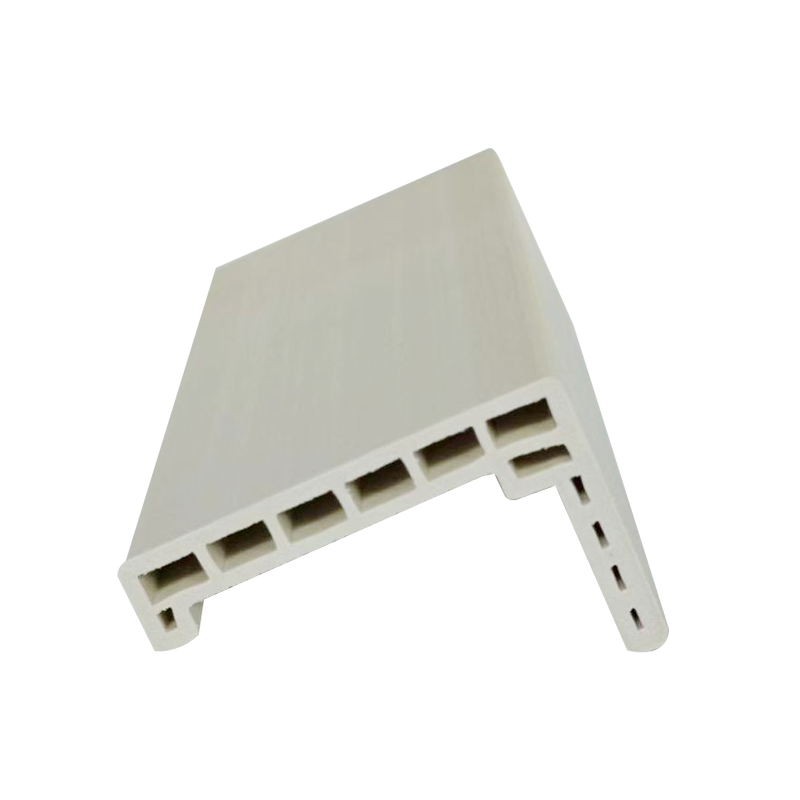
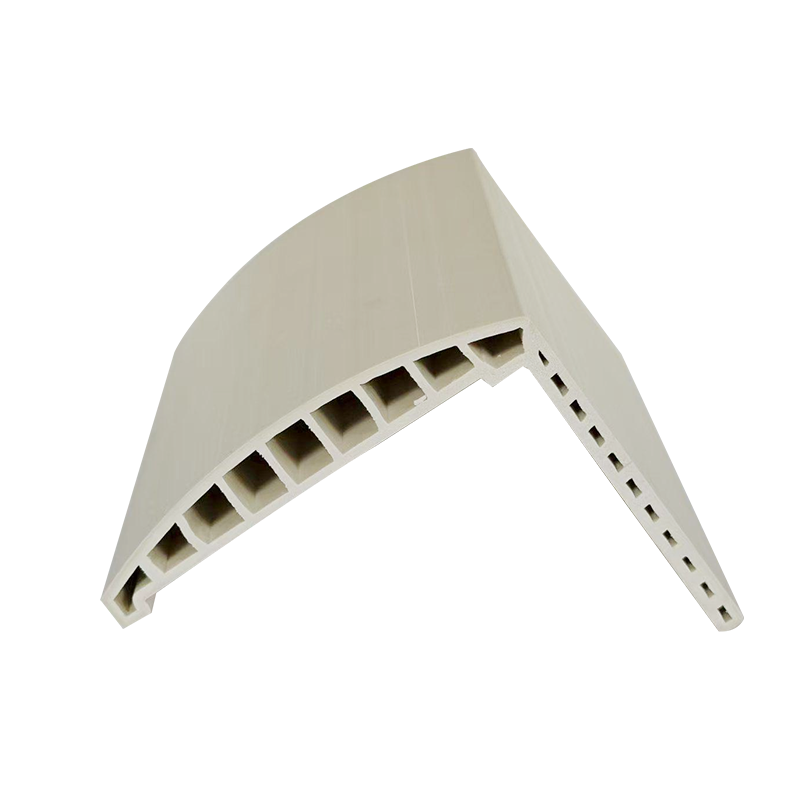
Hangzhou Lanyun New Materials Co., Ltd. produces WPC door architrave as part of a complete wood-plastic composite door system: door panels, frames, architraves, hardware and surface films from one factory in Lin'an District, Hangzhou. The architrave range covers flat and arc profiles in off-white, sized to close the joint between the door frame and the finished wall and to carry the same surface language as the leaf.
We supply these profiles to door assemblers, distributors, fit-out contractors and project teams that need trim which holds its shape in bathrooms, kitchens, laundries and other damp interiors, and which arrives dimensionally matched to the frames it is fitted against.
The WPC Door Architrave Range We Manufacture
Two profile families are in current production, both extruded from wood-plastic composite and finished in off-white. Flat profiles give a straight, minimal reveal; arc profiles carry a rounded face for a softer, more traditional casing line. Each family is offered in several face widths so a single specification can run across standard and wider openings.
Because the architrave is produced inside the same plant as the WPC Door Frame and WPC Door Panel, colour and surface texture can be aligned across the whole doorway rather than sourced as a separate trim package.
Why Wood-Plastic Composite Suits Door Casing
Architrave lives in the least forgiving part of a doorway: the bottom 300 mm, where mops, splashes and condensation reach first. Solid timber trim swells, splits and lifts paint in that zone. The composite formulation we extrude resists water uptake, so the profile keeps its section and its joint line through repeated wetting and drying.
- Moisture stability. Profiles hold dimension in bathrooms, laundries, spa areas and commercial washrooms where humidity swings are constant.
- No rot or insect attack. The polymer matrix removes the biological failure modes of natural timber.
- Wood-like appearance. Extruded and coated surfaces reproduce grain and warmth without the maintenance cycle of stained hardwood.
- Low upkeep. Cleaning is a damp cloth; there is no sanding, sealing or repainting schedule.
- Consistent section. Extrusion gives a repeatable profile along the full length, which matters when long runs of casing must line up.
Matching Architrave to Frame, Wall and Door Leaf
Architrave selection is a jointing decision before it is a decorative one. The profile must cover the frame-to-wall gap, sit flat against the plaster or board, and return cleanly at the mitre. We work from the frame section and the wall build-up to confirm which width and depth combination closes the detail without packing.
Coverage and width
A wider face is needed where the frame sits proud of the wall or where plaster thickness varies. The 100 mm faces in both families cover most site tolerances; the 60 mm and 80 mm flat profiles suit tight reveals and slim modern casings.
Return depth
The second dimension in each size is the return that meets the frame face. It must be deep enough to hide the frame edge and shallow enough that the architrave does not stand off the wall. We confirm this against the frame drawing supplied with the enquiry.
Finish continuity
Where a project uses WPC Flat Door or WPC Carved Door leaves, the architrave finish is specified alongside the leaf so the doorway reads as one assembly. Coating and film options are discussed at quotation stage.
Production Capacity Behind the Profile Range
Lanyun operates a production facility of more than 20,000 m² with a 10,000 m² factory floor, running over 12 WPC door extrusion lines and 10 coating lines. Annual capacity stands at 300,000 sets of WPC doors and 150,000 sets of melamine wooden doors. Architrave is extruded and finished within that same operation, which keeps profile supply tied to the door programme rather than to a third-party trim source.
Raw material control runs from supplier screening and audit through incoming material testing and comparison, so the compound feeding the architrave lines is checked before extrusion. A complete ERP system coordinates order handling and stock distribution across the range.
Custom Profiles and Project-Specific Sections
Standard sizes cover most residential and commercial work. Where a project calls for a different face width, return depth or moulded detail, we develop and produce architrave to customer drawings or physical samples. That route is normally taken when a doorway design must match an existing heritage profile, when a frame system has a non-standard rebate, or when a distributor wants a signature section.
- Section drawing or sample profile with face width and return depth marked.
- Required length per piece and the packing length for shipment.
- Colour and surface direction, referenced to a leaf or frame finish.
- End-use environment, so the compound and coating route suit the exposure.
Installation, Handling and Site Practicalities
WPC architrave is fixed in the same way as timber casing — pinned or adhered to the frame and wall, with mitred or butt returns at the head. Because the material does not absorb water, adhesive selection and substrate preparation matter more than sealing against moisture. We supply guidance on fixing and on acclimatising bundles before installation so profiles are laid flat and true when they go on the wall.
Profiles are packed to protect the coated face in transit and storage. Lengths, bundle quantities and labelling are agreed per order so site teams can match architrave to the correct door set without opening every pack.
Information We Use to Configure Your Solution
A quotation for WPC door architrave is prepared from a small set of project inputs. With these, we can confirm profile, size, finish, quantity and packing without a round of assumptions.
| Input |
What It Determines |
| Frame section drawing |
Return depth and how the architrave meets the frame face |
| Wall build-up and reveal |
Face width needed to cover the joint |
| Profile style |
Flat or arc family, or a custom section |
| Finish reference |
Colour and surface to match leaf and frame |
| Doorway count and lengths |
Order quantity, cutting plan and packing |
| Destination and delivery schedule |
Packing method and shipment planning |
Frequently Asked Questions
Can WPC door architrave be used in bathrooms and other wet rooms?
Yes. The composite formulation resists water uptake, so the profile does not swell, rot or delaminate in bathrooms, laundries and commercial washrooms. It holds its section through steam and condensation, which is where timber casing usually fails first.
What sizes do you produce as standard?
The flat family runs at 60×38, 80×60 and 100×60 mm; the arc family at 100×46 and 100×88 mm. All are supplied in off-white. Other face widths and return depths are produced to drawing or sample.
Can the architrave match the door leaf and frame finish?
Yes. Architrave, WPC Door Frame and door leaf are produced within the same operation, so finish references can be aligned across the doorway. Send the leaf or frame reference with the enquiry and we confirm the matching route.
Do you make custom architrave profiles?
We develop and produce architrave according to customer drawings or samples. A dimensioned section with face width and return depth, plus the required lengths and finish, is enough for us to assess tooling and quote.
How is architrave packed for export?
Profiles are bundled with the coated face protected, labelled by profile and size, and packed to the lengths agreed for the order. Packing and labelling are confirmed at quotation so site teams can match architrave to the correct door set.
How do I request a quotation for WPC Door Architrave?
Send the frame section, wall detail, profile preference, finish reference, doorway count and destination. Our team returns a configuration and quotation covering profile, size, finish, quantity and packing. Lanyun is a WPC Door Architrave manufacturer and supplier based in Hangzhou, China, working with distributors and project teams worldwide.



 English
 中文简体
 عربى